


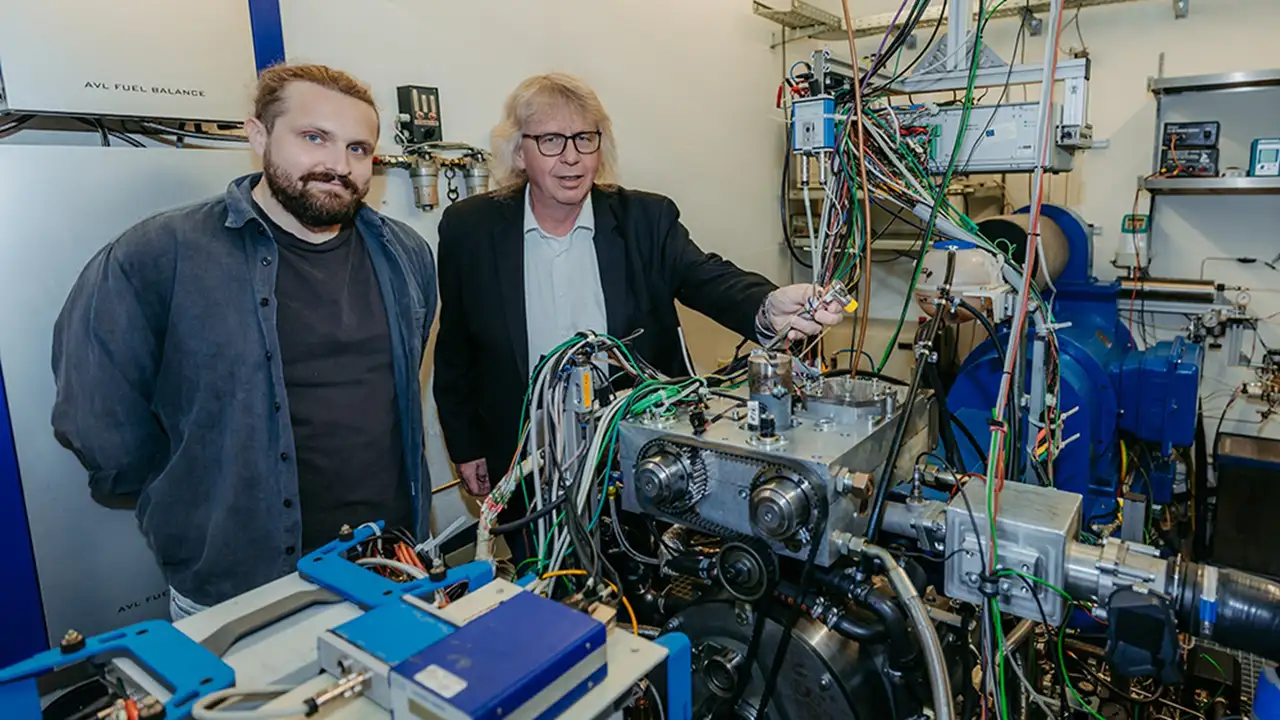
A hydrogen-powered engine developed in Germany operates without conventional exhaust emissions and achieves efficiency levels above 60 percent, delivering power output comparable to a diesel engine.
The closed-loop system from Otto-von-Guericke University Magdeburg reuses most of its working gases—hydrogen, oxygen, and argon—after each power stroke. The chemically inert argon acts as a stable carrier, creating more controlled thermodynamic conditions inside the engine to improve efficiency and stability.
The system cools, processes, and feeds the gas mixture back into the cycle after each stroke. It removes only specific byproducts and separates and liquefies the hydrogen involved in the reaction, enabling operation without producing conventional exhaust.
Hermann Rottengruber, PhD, professor at the university’s Institute for Engineering of Products and Systems (IEPS):
"This approach could become particularly important in applications where engines must operate under high loads for long periods, be highly robust, and deliver significant power."
The team tested multiple variants of the Argon Power Cycle engine on a dedicated test bench with research institute WTZ Roßlau gGmbH and validated performance through computer simulations.
The results make the engine particularly attractive for heavy-duty applications where battery-electric solutions often struggle due to weight, range, and charging infrastructure. These include long-haul trucks, agricultural machinery, construction equipment, and stationary power generators.
Rottengruber also pointed to potential economic advantages.
"In our assessment, the closed system could be more cost-effective over realistic operating periods than an open hydrogen combustion engine," he stated.
This potential cost-effectiveness stems from the elimination of expensive exhaust treatment systems and the high efficiency of the process, which could offset the engine's greater technical complexity over time.
The current concept faces limits in power density, as only a certain amount of hydrogen can be injected during each cycle. The team also noted that carbon dioxide could accumulate in the system, for instance, through the combustion of lubricants. Source: Interestingengineering