


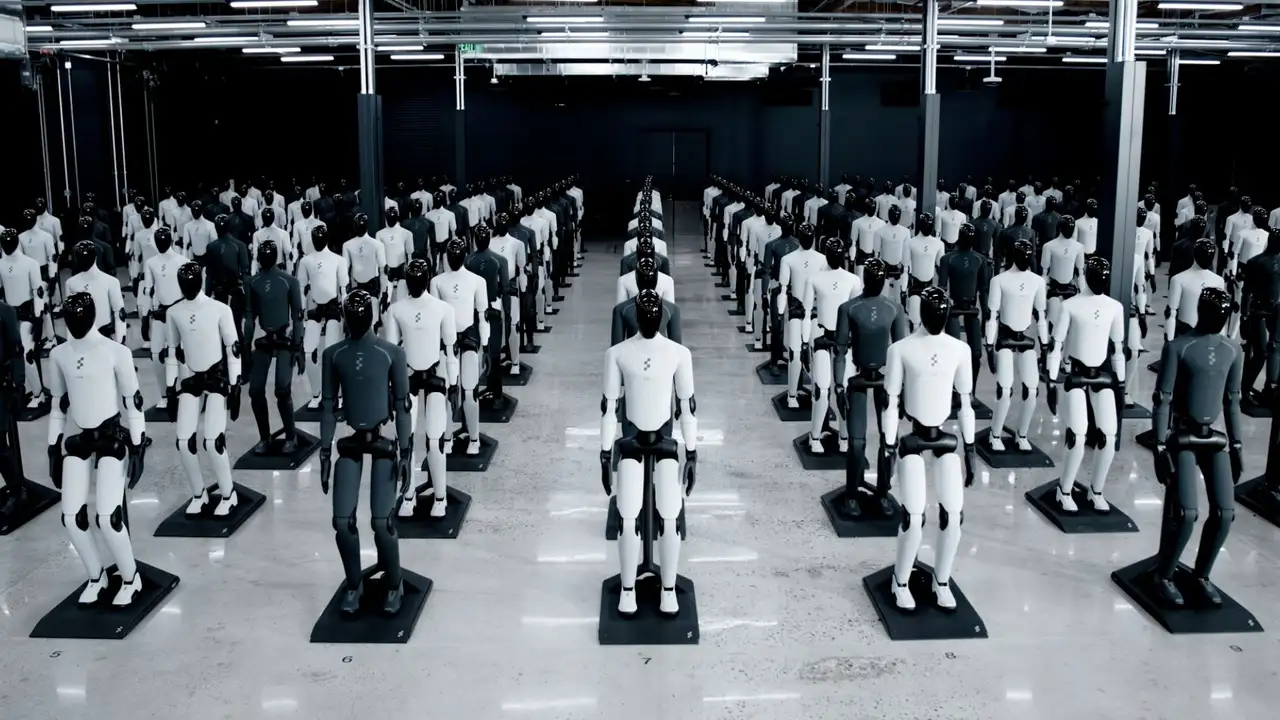
Figure's BotQ factory in California now completes a new Figure 03 humanoid robot every hour, a twenty-four-fold increase in output achieved in just under four months. The company has delivered more than 350 units from the facility, which operates over 150 networked workstations running custom manufacturing software.
The production ramp has pushed end-of-line first-pass yield above 80 percent. Battery production yield is reported at 99.3 percent, with over 500 units shipped and more than 9,000 actuators produced. Each assembled robot undergoes over 80 functional tests, including stress and burn-in exercises like performing squats and jogging.
The scaling effort is central to the company's data strategy. A growing fleet of robots generates large-scale operational data for training Helix, Figure's AI model for humanoid control. This data is intended to advance autonomous capabilities for research, commercial, and domestic applications.
Figure has also upgraded its AI model, Helix System 0 (S0), to integrate perception. Previously relying only on proprioception—the internal sense of joint states and body motion—the model can now process visual input from onboard stereo cameras to build a 3D spatial representation. This allows the robot to navigate environments like stairs and uneven terrain.
The perception-conditioned control system is trained end-to-end using reinforcement learning in simulation across randomized terrains. Figure says the learned behaviors transfer directly to real-world robots without additional calibration, a step toward overcoming the long-standing sim-to-real challenge.
With high-volume production established, Figure has built internal systems for fleet management, over-the-air updates, and service. Software fallback systems are designed to maintain robot functionality during minor faults, while diagnostics focus on resolving edge-case failures. Source: interestingengineering