


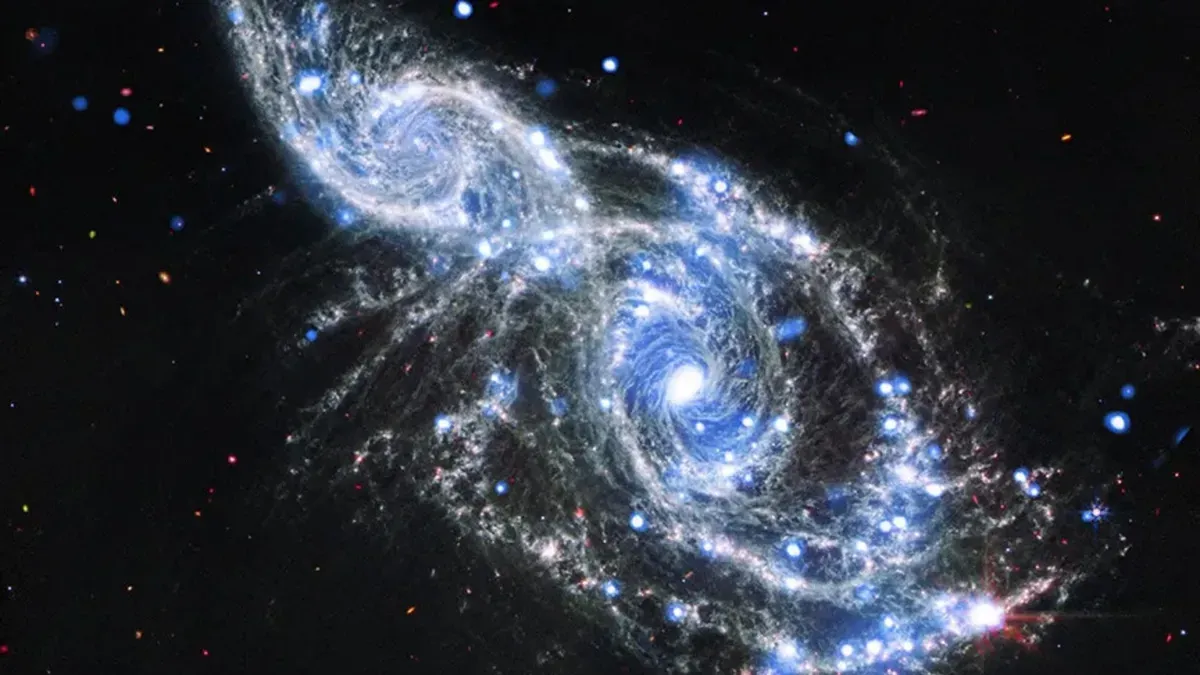
Two NASA telescopes have captured a 120-million-light-year-old galactic collision in a cosmic slow-motion dance that will culminate in a single galaxy billions of years from now.
The James Webb Space Telescope and Chandra X-ray Observatory jointly imaged the interacting galaxies IC 2163 and NGC 2207, revealing distinct astrophysical processes through their complementary observational capabilities.
Webb's infrared imaging from the Sun–Earth L2 point detects the dust and gas redistributed by the collision, while Chandra's X-ray observations from its elliptical Earth orbit trace high-energy phenomena like supernova remnants and active galactic nuclei.
The galaxies, located in Canis Major, have been gravitationally interacting for millions of years, with their spiral structures warped by tidal forces. This interaction redistributes interstellar material that may form new stars over extended timescales.
"Multi-wavelength observations are essential for understanding galaxy evolution," noted NASA astrophysicist Dr. Jane Rigby in a statement. "Webb and Chandra together show how different physical processes shape galactic structures across cosmic time."
The collision will ultimately merge the two galaxies, though this process will take billions of years to complete.
The composite image released by NASA illustrates the synergy of infrared and X-ray astronomy. Webb's data reveals the distribution of star-forming regions, while Chandra's X-ray data highlights the energetic consequences of gravitational interactions.
This combined approach allows scientists to study both the "bones" of galactic structure and the "heart" of energetic processes simultaneously.