


Rust code now runs in the stable Linux kernel for the first time. The promotion from experimental status, announced alongside Linux 7.0's release, marks the end of what the kernel community called the "Rust experiment" at the 2025 Linux Kernel Maintainers Summit.
Linus Torvalds delivered the 7.0 release with a note on how the kernel's development rhythm has shifted. Automated tools, particularly those powered by AI, are now surfacing edge cases faster than manual review once did.
Linus Torvalds, Linux kernel creator and maintainer:
"I suspect it's a lot of AI tool use that will keep finding corner cases for us for a while, so this may be the 'new normal' at least for a while. Only time will tell."
The Rust integration means developers can now write kernel drivers and subsystem code in a memory-safe language without maintaining out-of-tree patches. For end users, the change is invisible today. The first Rust-based drivers shipping in 7.0 cover hardware that already had C implementations, including Apple Type-C PHYs and Google Tensor SoC USB PHYs.
Architectural additions in 7.0 include atomic 64-byte load and store instructions for ARM64, RISC-V Zicfiss and Zicfilp extensions for control-flow integrity, and 128-bit atomic compare-exchange on LoongArch. These enable faster synchronization primitives on server and embedded silicon that supports them.
File system changes touch Btrfs, XFS, EROFS, F2FS, and NTFS3. Btrfs gains direct I/O for block sizes exceeding page size. XFS adds autonomous self-healing. A new nullfs provides an immutable root filesystem option for container and embedded use. EROFS now defaults to LZMA compression.
Security updates include SELinux support for BPF token access control, ML-DSA post-quantum signature verification, and expanded NETFILTER_PKT logging that captures both source and destination addresses. KVM on AMD Zen5 or later can now virtualize ERAPS, the Enhanced Return Address Predictor Security feature. Networking additions cover AccECN congestion notification, network namespaces for VSOCK sockets, and preliminary Wi-Fi 8 (802.11bn Ultra High Reliability) support. Driver updates span Qualcomm's Kaanapali platform, MediaTek Dimensity 6300 and 9200 DMA controllers, and Dell OptiPlex 7080 systems.
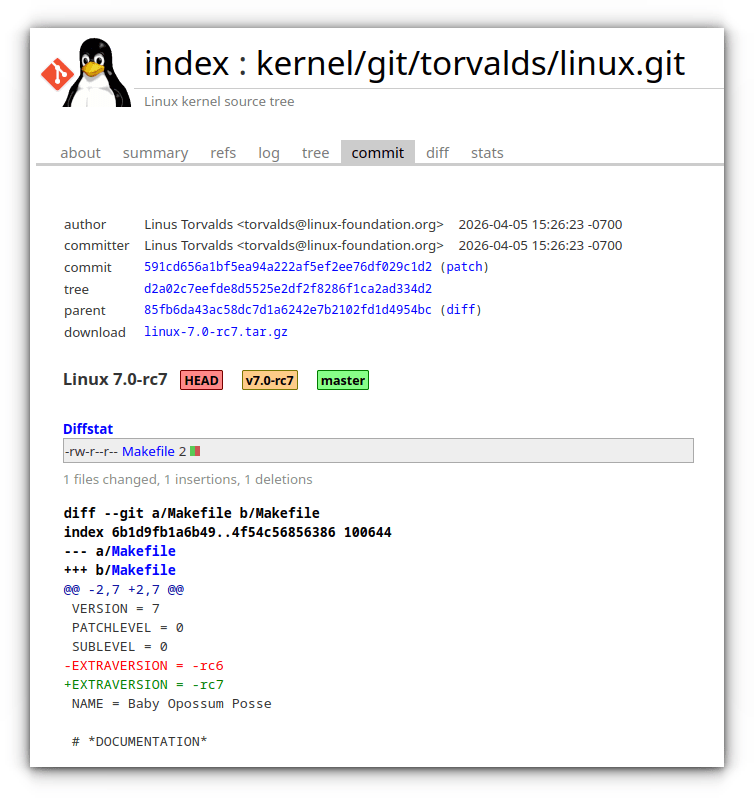
The kernel is available now from kernel.org and Torvalds' git tree. Most distributions will not ship 7.0 immediately. Stable repository updates typically lag release by weeks to months while vendors validate against their configurations. Users compiling from source assume responsibility for their own testing.
The merge window for Linux 7.1 opens after 7.0's release. The first release candidate is scheduled for April 26, 2026, with a stable release expected in mid-June 2026.
Source: 9to5linux