


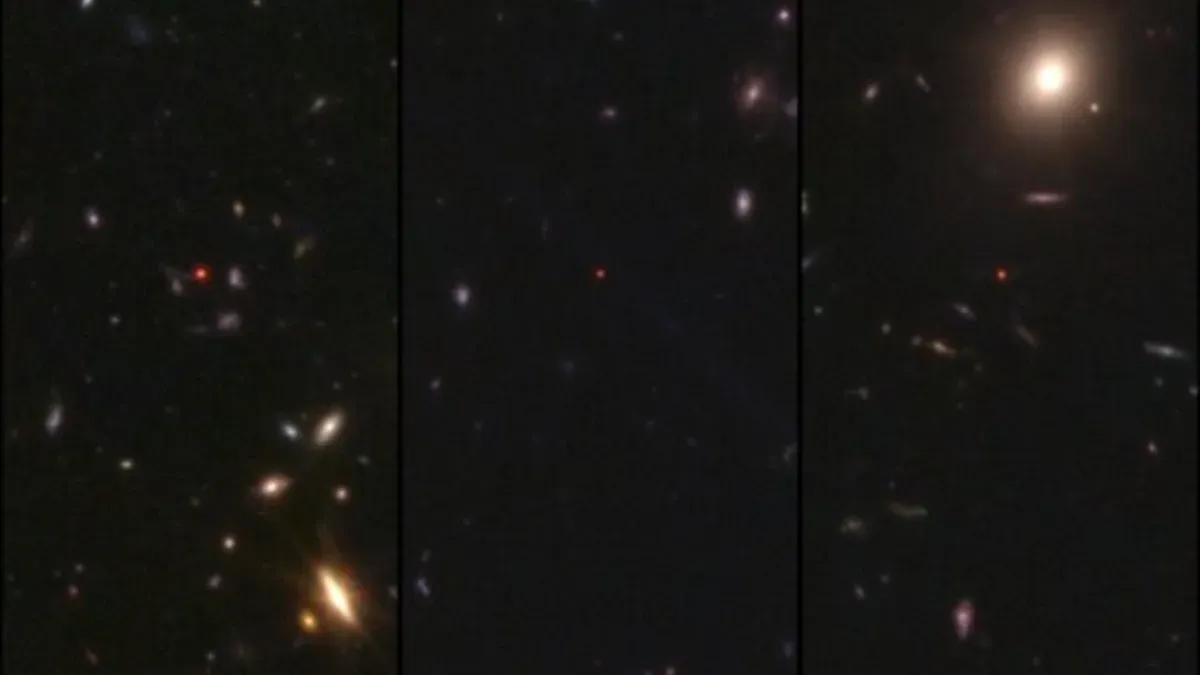
The James Webb Space Telescope has revealed ancient cosmic objects so luminous and compact they defy conventional explanations for their existence. A January 15, 2024, study in Nature reports that 12 galaxies observed by JWST appear to host supermassive black holes despite forming when the universe was only 840–1.8 billion years old.
These objects, described as 'little red dots,' emit light equivalent to 250 billion suns yet occupy regions smaller than 0.3 light-years. Gas velocity measurements of ~1.08 million km/h suggest black hole masses ranging from 100,000 to 10 million solar masses.
Lead author Vadim Rusakov noted, 'If they were purely made of stars, they would be the densest galaxies in the universe.'
The absence of detectable X-ray and radio emissions remains unexplained by traditional models. The team proposes an ionized gas 'cocoon' hypothesis, which could block radiation.
'They have an almost perfect disguise that removes X-ray and radio emission,' the researchers argue. This finding challenges existing timelines for supermassive black hole formation, as such massive objects typically require billions of years to develop.
Current constraints distinguish these findings from earlier black hole mass estimates by quantifying spatial dimensions and spectral characteristics. The compactness of these objects rules out stellar origins, as no known stellar system could compress such luminosity into such a small volume.
However, the study acknowledges the need for further observations to confirm the gas cocoon hypothesis and refine mass estimates.