JWST Confirms Supermassive Black Hole Escaping Galaxy at 2.2 Million Mph
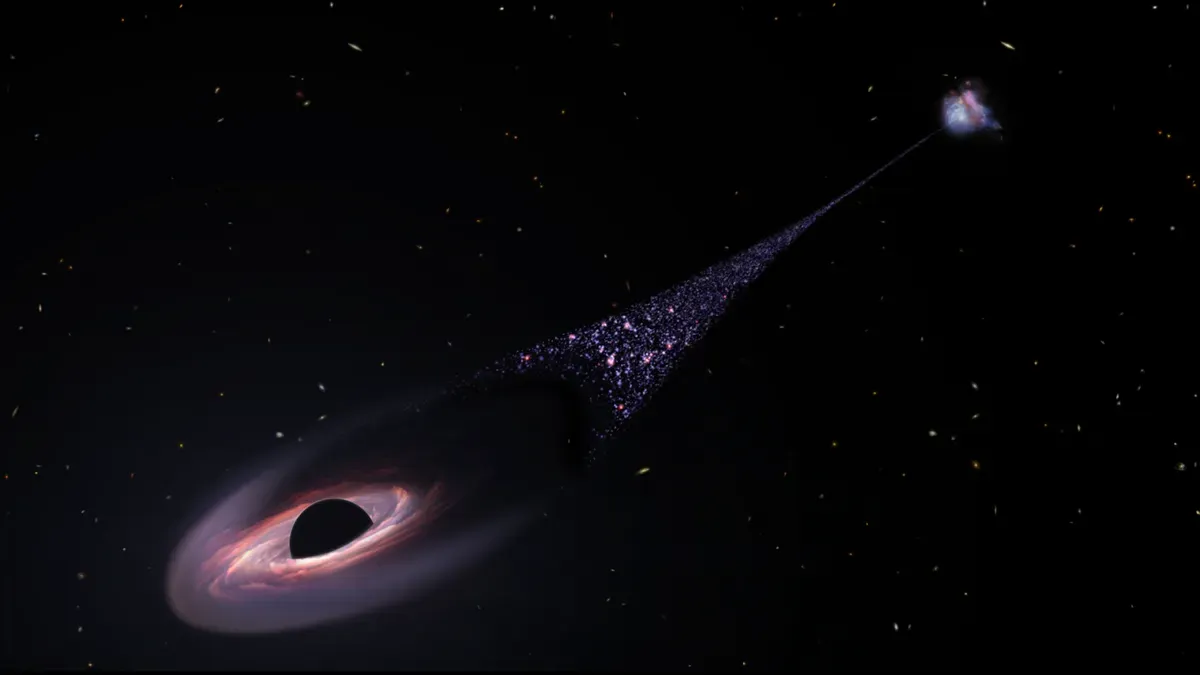
A supermassive black hole is fleeing its galaxy at 2.2 million mph, leaving a cosmic wake of stars 200,000 light-years long. The James Webb Space Telescope (JWST) detected a "bow shock" from the black hole, confirming its escape from its host galaxy.
The observation includes a 200,000-light-year-long "wake" of young stars and a shockwave captured via JWST's mid-infrared instrument.
The black hole's mass is 20 million times that of the Sun, with data aligning across wavelengths from Hubble and Keck observations.
The study, published as a preprint on Arxiv (Dec 3, 2024), remains unpeer-reviewed but builds on prior work by lead author Pieter van Dokkum of Yale University. Van Dokkum described the situation as "a significant finding" that "demands further investigation."
Key methodological considerations include JWST's mid-infrared imaging capabilities and the alignment of findings with multi-wavelength data.
The team emphasizes that while the observations are compelling, peer-reviewed validation is pending. Theoretical context suggests binary or trinary black hole interactions as potential ejection mechanisms, though this remains speculative.