


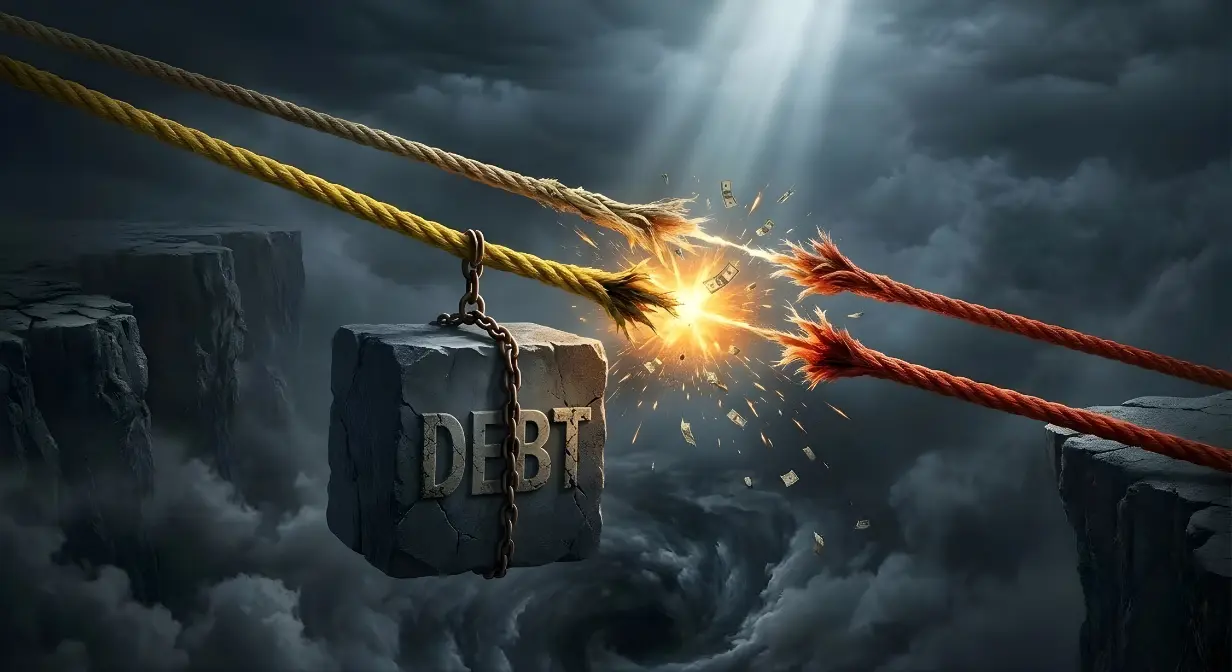
The fiscal elastic band has been stretched for decades—what happens when it finally snaps? Public debt now exceeds annual economic output in several major advanced economies, the highest peacetime levels on record.
Era Dabla-Norris and Rodrigo Valdes of the IMF warn that rising debt and high interest rates leave governments with a shrinking menu: raise taxes, cut essential services, stoke inflation, or borrow more. Their blunt question: "How much stretch is left for the next crisis?"
Alan Auerbach points to Washington. U.S. political polarization blocks any bipartisan path to higher taxes or lower spending, so the technical fixes sit on the shelf. Alan Blinder argues the deeper problem is dialectical: economists and politicians no longer speak the same language, so even good ideas die in translation.
Atif Mian labels the global pattern indebted demand: excess saving by the rich and by China props up growth through ever-larger balance-sheet holes. The model is inherently fragile; when sentiment shifts, demand collapses faster than central banks can print.
Zsolt Darvas and Jeromin Zettelmeyer run the numbers for France and Germany, then point to Greece, Ireland, and Portugal as post-crisis paragons of discipline. Their arithmetic says the core of Europe still needs sizable primary surpluses, yet voters in Paris and Munich have not signed up for the required belt-tightening.
Giancarlo Corsetti and Leonardo Melosi offer a sobering coda: sustainable adjustment may require pragmatic tolerance of periods of above-target inflation when geopolitical shocks hit supply. In short, price stability could be sacrificed on the altar of debt service.
History shows one political constant.
"History shows that people are more likely to accept painful reforms if they believe the burden is shared fairly."
Innovation—faster growth, surprise productivity, a lucky terms-of-trade windfall—remains a hope, not a plan. Until that hope materializes, disciplined, transparent, burden-sharing reforms must start now; the elastic is already fraying.
Look, every forecast in this debate hinges on a single variable: whether electorates trust that the pain will be distributed evenly. Without that trust, even the best technical roadmap is dead on arrival.
⚠️ LEGAL DISCLAIMER: This article is for informational purposes only and does not constitute financial or investment advice.
Source: IMF