


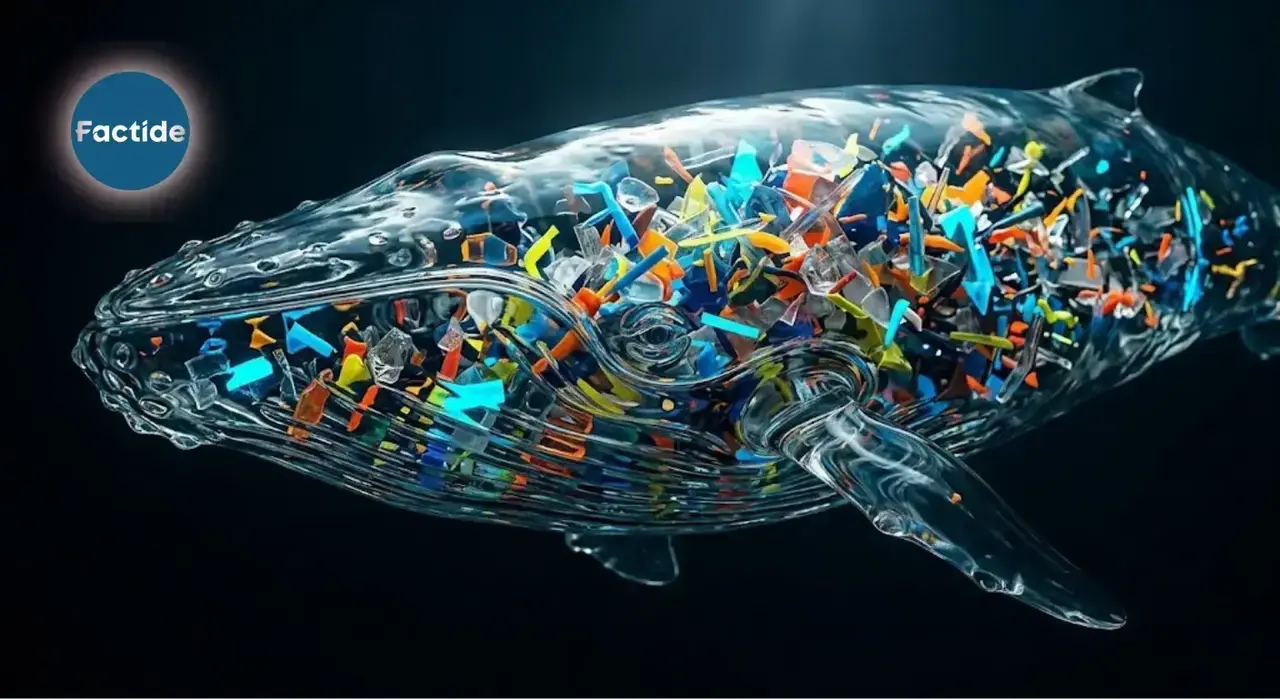
For years, something didn't add up. Scientists could calculate how much plastic humanity had produced, how much had made its way into the ocean — but when they went looking for it, a staggering portion was simply gone. No traces on the surface. No debris washing ashore. Just… missing.
Now, a team of researchers from the Royal Netherlands Institute for Sea Research (NIOZ) and Utrecht University has cracked one of environmental science's most haunting cold cases. The plastic wasn't gone. It had transformed into something far more insidious: trillions upon trillions of nanoplastic particles, invisible to the naked eye and now woven into the very fabric of the ocean — and life itself.
The findings, published in the journal Nature, represent the first meaningful scientific estimate of nanoplastic concentrations in ocean water, and they have sent shockwaves through the scientific community.
A Research Voyage Into the Invisible
To track down what no one could see, the team sent Utrecht master's student Sophie ten Hietbrink aboard the research vessel RV Pelagia for four weeks. The ship carved a path across the open Atlantic, from the Azores to the European continental shelf, stopping at 12 carefully chosen locations to collect water samples.
Each sample was run through a fine filter — anything larger than one micrometer was removed. What remained was the invisible residue of a plastic civilization. Back at the Utrecht laboratory, researchers dried and heated the material, then analyzed it using mass spectrometry, a technique sensitive enough to identify the chemical fingerprints of different plastic types.
The result was the first hard data the scientific world had ever seen on ocean nanoplastics at scale.
27 Million Tons — Just in the North Atlantic
When the team extrapolated their measurements across the full breadth of the North Atlantic, the number that emerged was staggering.
"This estimate shows that there is more plastic in the form of nanoparticles floating in this part of the ocean than there is in larger micro- or macroplastics floating in the Atlantic or even all the world's oceans!" — Helge Niemann, researcher at NIOZ and professor of geochemistry at Utrecht University
Twenty-seven million tons. In one ocean basin alone.
"A shocking amount." — Sophie ten Hietbrink
The scale of the finding reframes everything we thought we knew about plastic pollution. The "missing" plastic — the portion scientists couldn't account for — hadn't vanished. It had fractured, disintegrated, and dispersed into particles measured in billionths of a meter, now suspended throughout the ocean in quantities that dwarf any visible plastic debris on Earth.
How Plastic Becomes Invisible
Nanoplastics don't appear out of nowhere. They're the end product of a slow, relentless disintegration. Larger plastic debris — bottles, bags, fishing nets — gets battered by UV radiation from the sun, breaking apart piece by piece over years and decades into ever-smaller fragments.
Rivers ferry plastic particles from cities and farmland straight into the sea. But there's another pathway that surprised even experts: the atmosphere. Nanoplastics can travel through the air, hitching rides on wind currents, before raining down into the ocean or settling onto the water's surface through a process called dry deposition.
This research breakthrough was made possible in part by bridging two scientific worlds — merging ocean science with atmospheric expertise, including contributions from Utrecht University scientist Dušan Materić.
It's in the Food. It's in the Air. It's in the Brain.
The implications of 27 million tons of invisible plastic drifting through the ocean are difficult to overstate. Nanoplastics, by their very nature, are small enough to slip through biological barriers that would stop larger particles.
"It is already known that nanoplastics can penetrate deep into our bodies. They are even found in brain tissue." — Helge Niemann
These particles don't just float passively. They move through food webs — consumed by microorganisms, passed along to fish, and ultimately reaching the humans who eat seafood. The full scope of what this means for ecosystems and human health remains an open and urgent question, demanding far more research than currently exists.
What Science Still Doesn't Know
As groundbreaking as this study is, it also illuminates the edges of what remains unknown. Notably, the team did not detect certain common plastics — including polyethylene and polypropylene — in the smallest particle size range. Niemann offered a candid explanation:
"It may well be that those were masked by other molecules in the study."
The research was also geographically focused on the North Atlantic. Whether similar concentrations exist in the Pacific, Indian, or Southern Oceans remains unconfirmed — though early indications suggest the answer may be yes.
Niemann was recently awarded a 3.5 million euro grant to continue investigating nanoplastics and what ultimately happens to them — a recognition of just how much science still doesn't understand about the particles now saturating our world.
The Terrible Truth: There's No Cleanup
Perhaps the most sobering conclusion of this research is the one that offers no hope of reversal.
Unlike plastic bottles that can be fished from the sea, or microplastics large enough to filter, nanoplastics are beyond any cleanup technology humanity currently possesses — or is likely to develop anytime soon.
"The nanoplastics that are there can never be cleaned up." — Helge Niemann
The ocean has already absorbed what it has been given. The only path forward, scientists say, is the one that runs through prevention — stopping plastic from entering the environment before it has a chance to break down into something permanent and pervasive.
The missing plastic has been found. It is in the water we sail on, the fish we eat, the air we breathe — and according to the science, it is already inside us. The question now is not where it went. The question is what it will do next.
Journal Reference: Sophie ten Hietbrink, Dušan Materić, Rupert Holzinger, Sjoerd Groeskamp, Helge Niemann. Nanoplastic concentrations across the North Atlantic. Nature, 2025; 643 (8071): 412. DOI: 10.1038/s41586-025-09218-1
Source: Royal Netherlands Institute for Sea Research (NIOZ)