


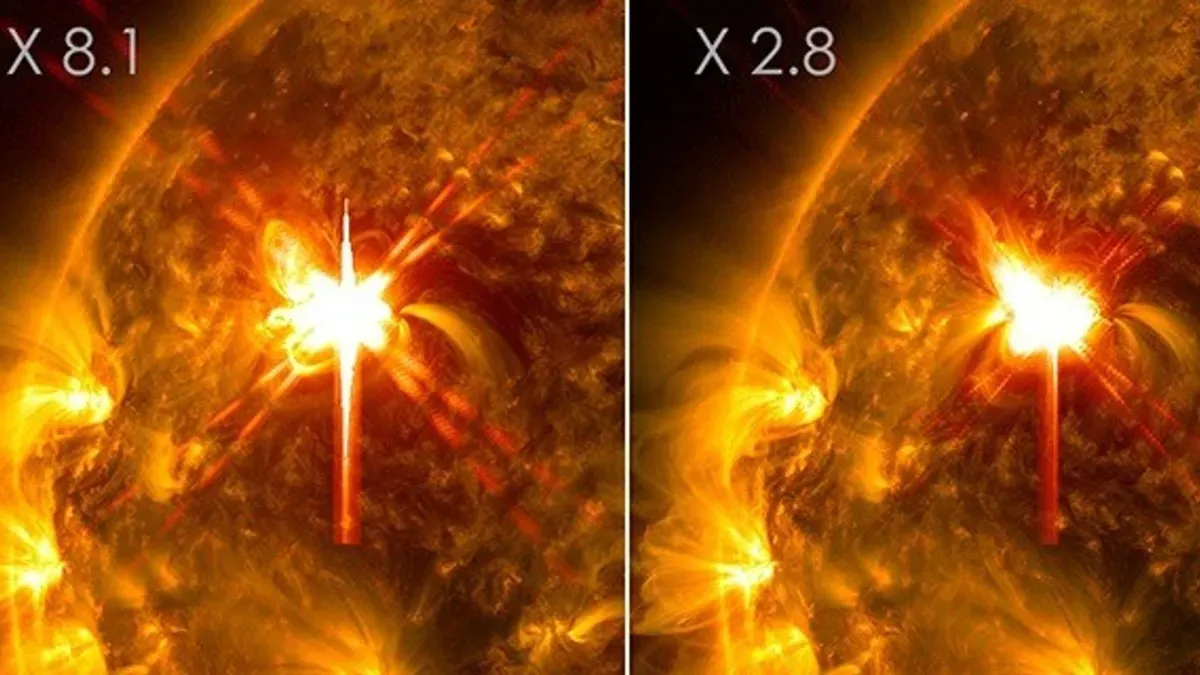
A massive sunspot unleashed 27 solar flares in 24 hours, including the strongest eruption since 2024, sending a coronal mass ejection toward Earth.
Sunspot region 4366 emitted 23 M-class and four X-class flares, with the X8.1-class flare marking the most intense solar outburst since October 2024’s X9.0 event. The coronal mass ejection (CME) launched on Feb. 1 is expected to pass Earth on Feb. 5, potentially delivering a glancing blow that could elevate geomagnetic activity.
NOAA’s Space Weather Prediction Center (SWPC) issued a statement noting, “Elevated geomagnetic activity — possibly resulting in vibrant northern lights at lower latitudes — is possible Thursday.” The agency emphasized that aurora visibility would depend on the CME’s trajectory and intensity, with current models suggesting a moderate risk of auroral displays at mid-latitudes.
Sunspot 4366, half the size of the 1859 Carrington Event sunspot, has become a focal point during the current solar maximum (2024-2026). Previous CMEs from this period have already produced auroras as far south as Florida, though the likelihood of similar phenomena this week remains under evaluation.
NASA and NOAA have not issued warnings about power grid disruptions or satellite communication risks, citing the CME’s expected glancing blow rather than a direct impact.
The Carrington Event comparison is offered as historical context rather than predictive speculation. Modern solar monitoring infrastructure, including the Solar Dynamics Observatory and the Deep Space Climate Observatory, allows for real-time tracking of solar activity. Scientists stress that while the current flare rate is notable, it remains within the expected range for a solar maximum cycle.