


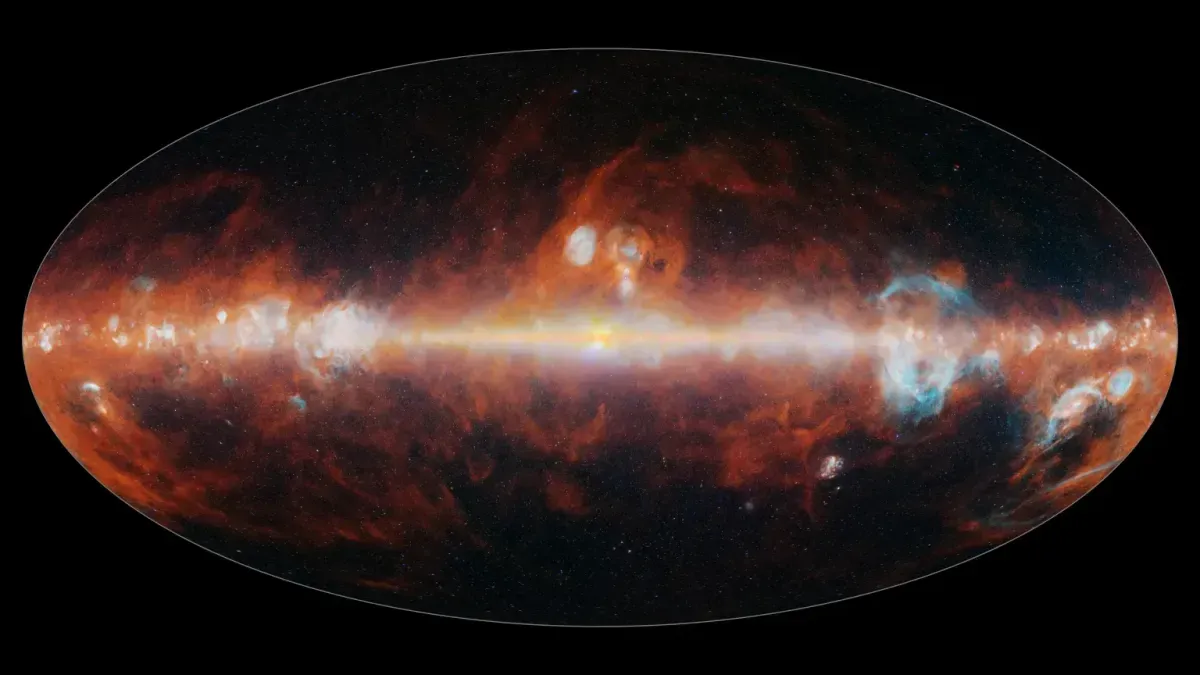
NASA's SPHEREx telescope has released its first full-sky map combining 100 infrared observations, marking a significant milestone in cosmic research. The mission, launched on March 12, 2025, with a $488 million budget, captures 3,600 images daily to map 450 million galaxies over its two-year duration.
These data include 102 distinct infrared wavelength maps, providing insights into cosmic inflation and the distribution of icy comet material.
"It's incredible how much information SPHEREx has collected in just six months," stated a NASA official. The telescope's findings are expected to benefit astronomers globally, with one researcher noting, "I think every astronomer is going to find something of value here."
However, a peer-reviewed study in Nature warns that 96% of SPHEREx exposures may be affected by satellite megaconstellations, which are projected to grow from 15,000 to 1 million units by the 2030s. This risk is not addressed in NASA's official mission documentation.
SPHEREx's primary objectives focus on mapping the universe's large-scale structure and studying the conditions of the early cosmos.
The telescope's data will complement existing missions like the James Webb Space Telescope, though its infrared capabilities are distinct in their wavelength coverage and survey scope.
The satellite's operations are designed to withstand typical space debris risks, but the rapid expansion of low-Earth-orbit megaconstellations introduces an unanticipated challenge for future astronomical observations.