Solar Flare and CME Trigger Potential Severe Geomagnetic Storm Conditions
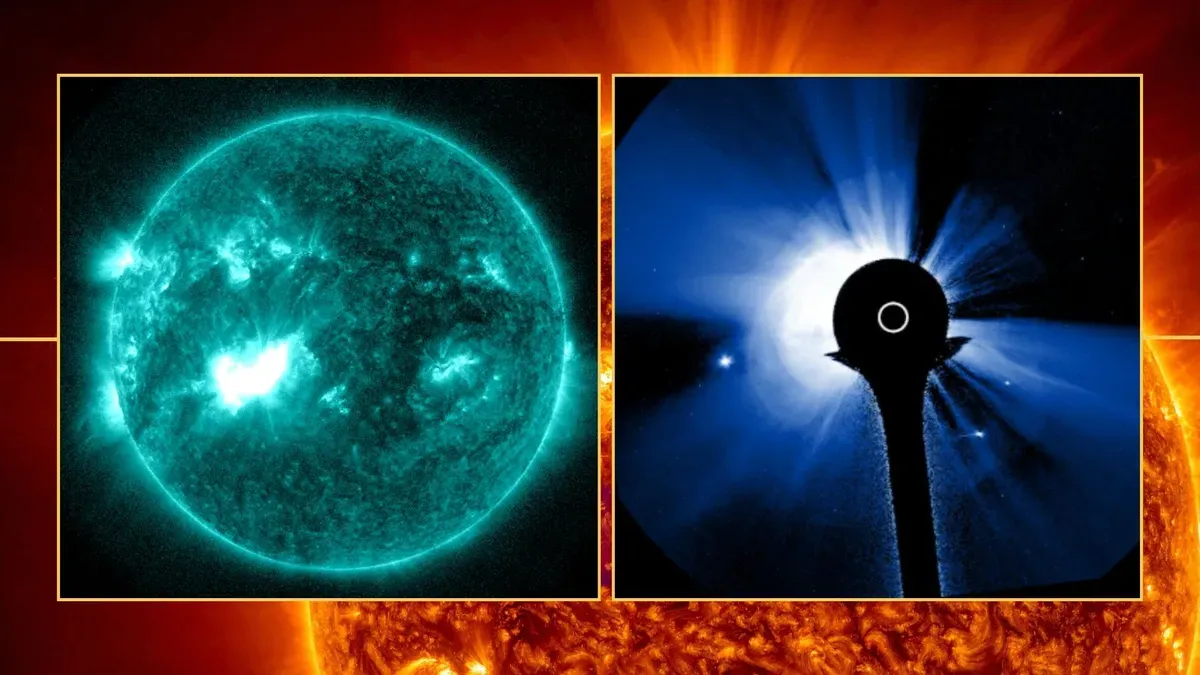
A solar flare of X1.9 magnitude erupted from sunspot AR4341 at 1:09 p.m. EST (1809 GMT), triggering a coronal mass ejection (CME) directed toward Earth. The U.K. Met Office forecasts potential G3 (strong) to G4 (severe) geomagnetic storm conditions if the CME's southward-oriented Bz magnetic field component aligns with Earth's magnetosphere.
NOAA reported R3 radio blackouts over the sunlit hemisphere, most severe in the Americas, as the flare's energy propagated through the solar system.
The CME's trajectory and magnetic orientation will determine the storm's intensity. Spacecraft such as DSCOVR and ACE will provide real-time data on the Bz component as the CME approaches.
Current models suggest auroras could become visible as far south as 45° latitude (Northern California/Alabama) if the storm reaches G3-G4 levels. However, the U.K. Met Office emphasizes that these projections remain conditional on the CME's magnetic field alignment.
Observations from the Solar and Heliospheric Observatory (SOHO) and the Solar Dynamics Observatory (SDO) confirm the flare's classification and CME trajectory.
Predictive models, while based on historical CME behavior, cannot yet quantify the exact impact without real-time magnetic field data. The scientific community awaits DSCOVR's magnetometer readings to refine storm severity forecasts.