Sequence of Solar Eclipses from 2026 to 2028 Includes Three Total and Three Annular Events
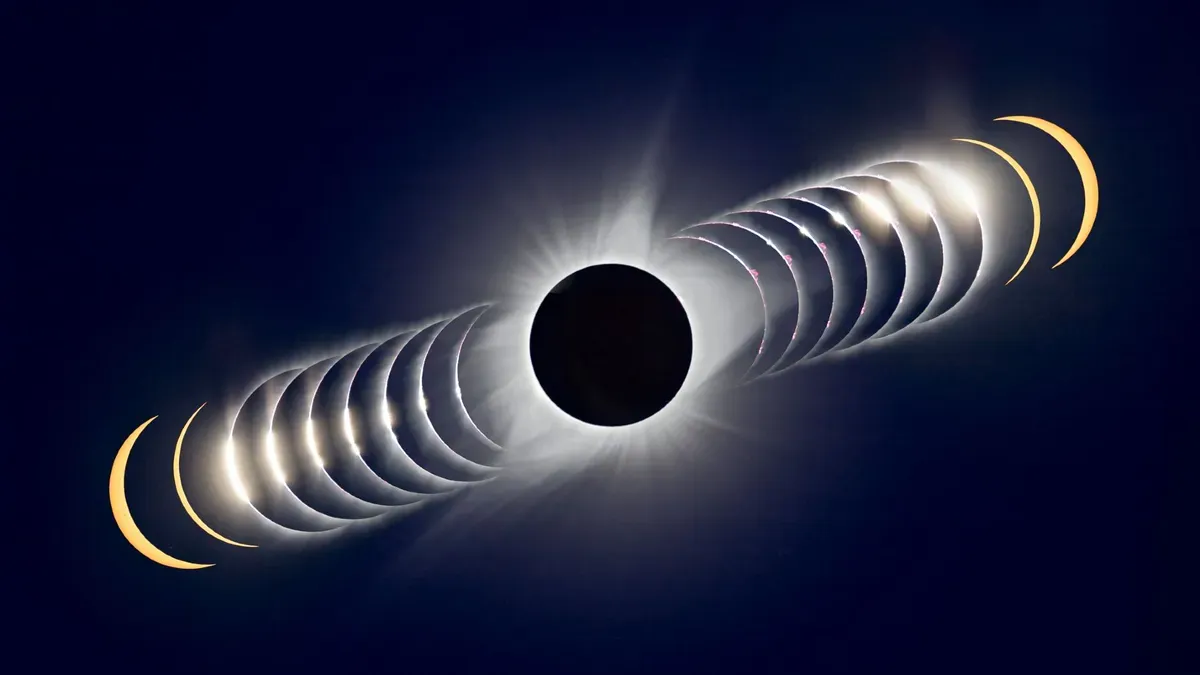
From 2026 to 2028, three total solar eclipses and three annular eclipses will create a rare sequence visible from Europe, Africa, the Middle East, Australia, and parts of the Americas.
This pattern follows predictable astronomical cycles known as Saros sequences, which recur every 18 years and 11 days. Similar triplets occurred in 1990-1992 and 2008-2010, though the 2026-2028 sequence offers broader geographic accessibility for observers in densely populated regions.
The total solar eclipses will occur on August 12, 2026 (duration: 2 minutes 21 seconds), August 2, 2027 (6 minutes 22 seconds), and July 22, 2028 (5 minutes 24 seconds).
The 2027 event has been labeled 'the eclipse of the century' due to its extended totality and path crossing cultural landmarks such as Luxor, Egypt. The annular eclipses will take place on February 17, 2026; February 6, 2027; and January 26, 2028, with the 2027 annular eclipse uniquely crossing both the Galápagos Islands and Spain.
Geographic accessibility varies across the sequence. The 2026 eclipse will be the first total solar eclipse visible from mainland Europe since 1999, while the 2028 event will mark the first total eclipse visible from Sydney, Australia, since 1857.
All three total eclipses will occur during Northern Hemisphere summer, increasing observational opportunities for researchers and amateur astronomers. The 2027 eclipse will also coincide with a third solar eclipse in Spain within 532 days, a rare occurrence for the region.
Total and annular eclipses differ primarily in the alignment of the Moon and Sun. During a total eclipse, the Moon completely covers the Sun’s disk, allowing visibility of the corona.
In an annular eclipse, the Moon appears smaller, leaving a bright ring of sunlight visible around the Moon’s edge. Both phenomena require precise orbital mechanics to occur, governed by the Moon’s elliptical orbit and Earth’s axial tilt.