


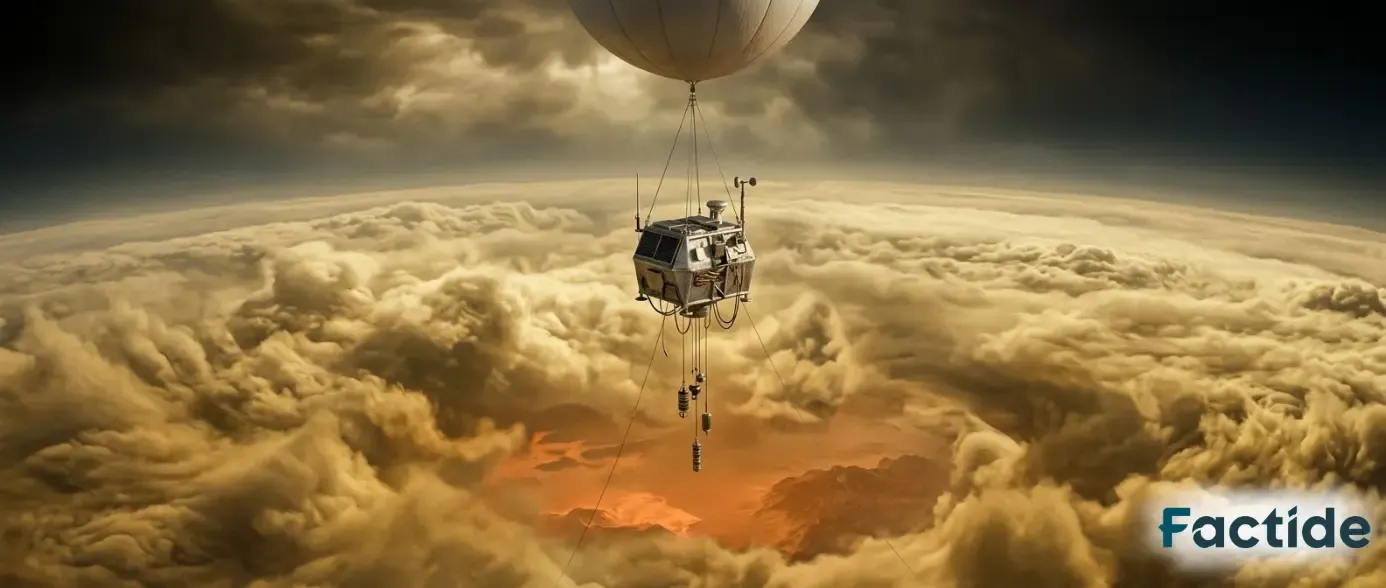
Russia wants to send a balloon, lander, and orbiter to Venus in 2036, reviving a legacy of survival in 900-degree surface heat last achieved by the Soviet Union four decades ago.
Roscosmos has set its sights on a 2036 launch for the revived Venera-D mission, according to Russian state media reports on 10 March. The architecture—an orbiter, a short-lived lander built to withstand 90-bar pressures, and a balloon that would drift through the middle cloud layer—reprises the engineering template that carried Soviet vehicles safely to the Venusian surface between 1970 and 1983.
First Deputy Prime Minister Denis Manturov framed the programme as a return to form, noting that “back in 1970, our country succeeded in successfully landing a spacecraft on another planet in the solar system. And that was Venus. Therefore, we will probably move in this direction first.” Development studies have been under way since 2003, but the current schedule now heads for a launch window in the mid-2030s.
Before 2022, NASA’s Jet Propulsion Laboratory had been exchanging payload proposals and trajectory analyses with Roscosmos. That cooperation ended after Russia’s invasion of Ukraine, leaving the mission fully under Russian institutes and industry partners.
Scientifically, Venera-D is driven by the contested 2020 claims of phosphine and, later, ammonia in the planet’s cloud tops—spectral signatures that some researchers argued could point to microbial metabolism.
Russian officials have echoed that rationale, listing the search for microbial life among the mission’s top-level goals. No new phosphine data are being released with the current announcement, and the broader community has yet to confirm the original detection.
If it flies, Venera-D would enter an increasingly crowded field of Venus-bound spacecraft. NASA’s VERITAS and DAVINCI missions recently survived 2026 budget threats, ESA is preparing the EnVision radar orbiter, and the Indian Space Research Organisation has unveiled plans for an as-yet-unnamed Venus orbiter. None of these carry entry probes, leaving the Soviet-era record—ten landers that functioned from minutes to two hours on the surface—unchallenged for the moment.
Much remains undefined. Roscosmos has not released detailed mass specifications, launch-vehicle selection, or a formal baseline for the balloon’s planned 55-km float altitude. Independent analysts note that thermal protection, battery life, and data-relay geometry will be critical design drivers for every element of the stack.
Source: Space