Rapid Pulsations of Red Giant R Leonis Signal Stellar Evolution
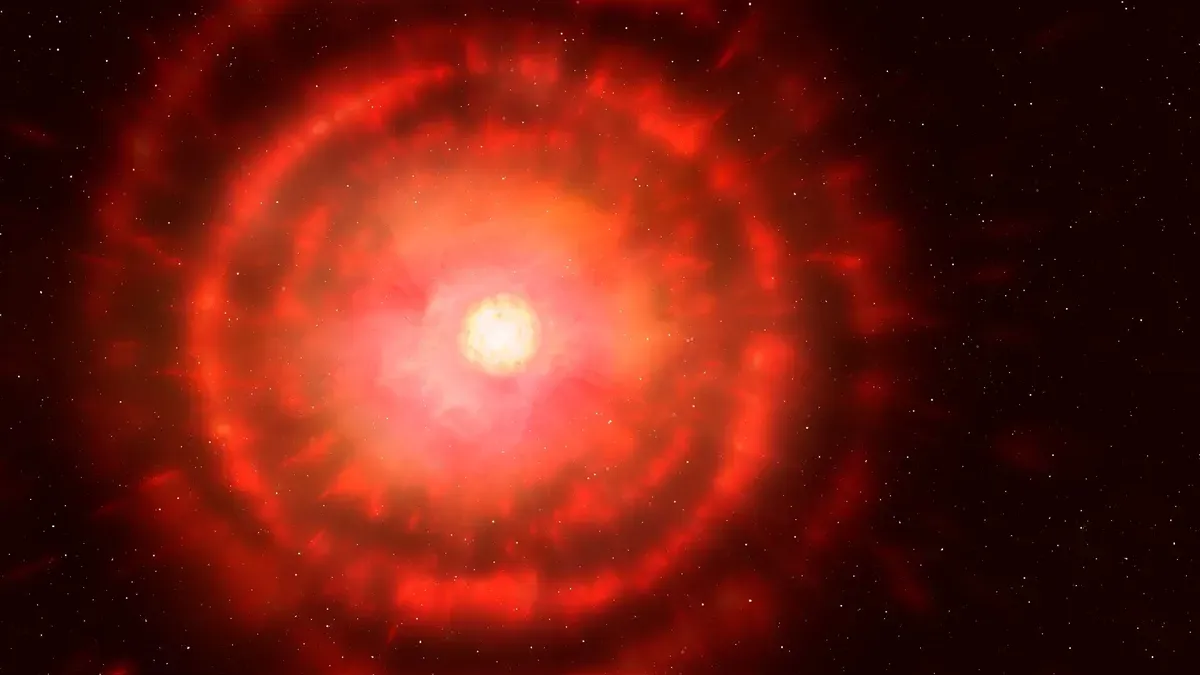
A red giant star’s 200-year-old pulsation rhythm is accelerating, offering an unprecedented glimpse into the chaotic final stages of stellar life.
R Leonis, a Mira variable in the constellation Leo, has exhibited regular pulsations for centuries. New analysis of 200 years of observational data—including archives from the American Association of Variable Star Observers (AAVSO)—reveals its pulsation period has shortened by three days since the 1800s.
The study, published in the peer-reviewed journal Monthly Notices of the Royal Astronomical Society and available as a preprint on arXiv, analyzed overlapping modulations on 35- and 98-year cycles.
These patterns suggest complex internal dynamics within the star. The researchers note that dust shells surrounding R Leonis appear to evolve in density, influencing observed brightness fluctuations.
Historical data limitations, particularly pre-CCD-era naked-eye observations, introduce potential uncertainties in interpreting long-term trends.
However, the paper concludes that the observed changes represent “real-time evolution” of the star’s structure. One author stated, “The star’s fundamental pulse... has shortened by about three days since the early 1800s.”
While the findings align with theoretical models of late-stage stellar evolution, the team emphasizes the need for further observations to confirm whether this acceleration reflects a transient phase or a permanent shift in the star’s behavior.
The interplay between dust shell dynamics and pulsation patterns remains an open question.