Prediction Markets: Institutional Adoption Amid Integrity Controversies
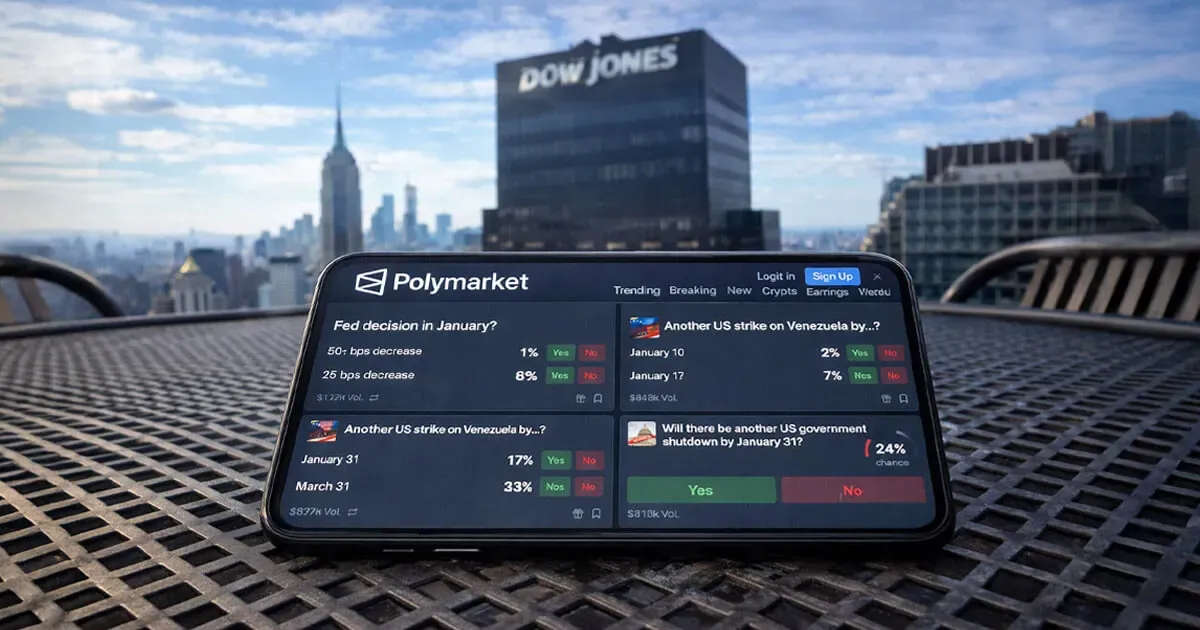
Prediction markets are gaining institutional traction despite persistent integrity disputes, raising questions about their legitimacy as financial data products.
The sector’s bifurcation between regulated platforms like Kalshi and unregulated models like Polymarket has created two distinct pathways for institutional adoption—data distribution versus consumer access.
Dow Jones, Barron’s, and MarketWatch have partnered with Polymarket to distribute prediction market probabilities, while Intercontinental Exchange (ICE) invested $2 billion in the platform to deliver event-driven data to institutional investors.
Meanwhile, Kalshi claims $100 billion in annualized trading volume, with CNN and CNBC integrating its probabilities into their reporting. Yet both platforms face unresolved disputes over market resolution, including Polymarket’s refusal to settle a $10.5 million 'US invasion of Venezuela' market and a $16 million UFO declassification bet reported by the Financial Times.
The structural risks extend beyond isolated incidents. A trader allegedly profited $400,000 from insider-like bets on Venezuela’s political future, while prediction market volume (Kalshi + Polymarket) reached $8.3 billion in December 2025—84.7% of Solana memecoin volume.
These figures highlight the tension between growth and governance as institutional players navigate uncharted regulatory terrain.
ICE and Kalshi represent divergent institutionalization strategies. ICE’s approach focuses on data distribution to institutional investors, whereas Kalshi prioritizes regulated consumer access.
This duality underscores the sector’s unresolved question: Can prediction markets function as reliable financial data products without a unified framework for dispute resolution?
Look, the $8.3 billion in prediction market volume outpacing Solana memecoins suggests institutional capital sees real value in these platforms. But without clear resolution protocols, the risk of reputational damage—and regulatory pushback—remains a ticking time bomb for the sector.
⚠️ LEGAL DISCLAIMER: This article is for informational purposes only and does not constitute financial or investment advice.