


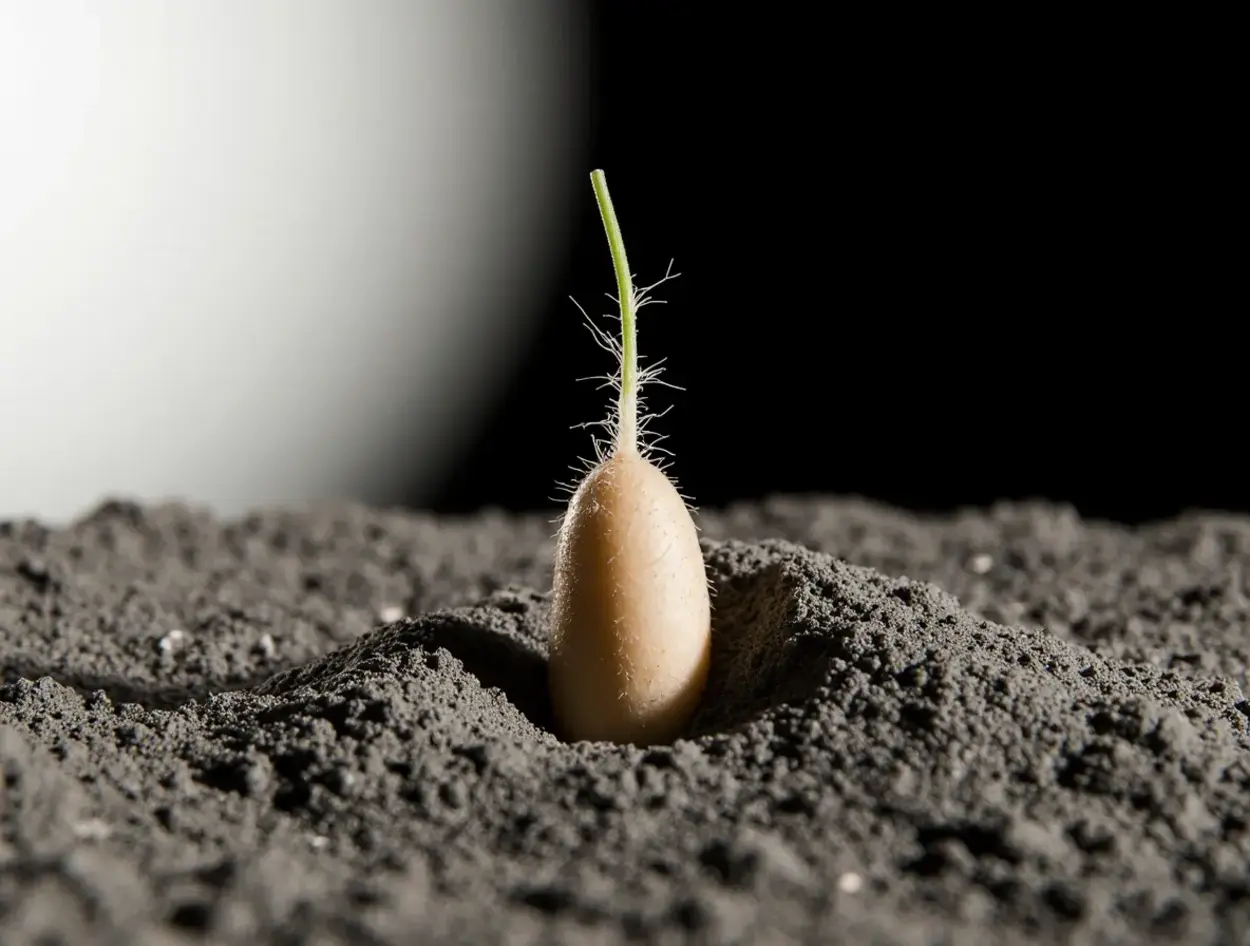
Mark Watney’s fictional feces-fertilized Martian potatoes have an unexpected lunar cousin. In a preprint posted on bioRxiv, researchers report that potato plants can germinate and form small tubers in a lunar-regolith simulant blended with just 5 % vermicompost, an earthy amendment produced by composting with worms.
The team filled growth trays with a commercial dust designed to mimic the mineralogy of Apollo samples, mixed in the organic matter, and allowed the plants roughly eight weeks under Earth-normal light, temperature, and humidity.
At harvest the potatoes were visibly smaller than soil-grown controls, and gene-expression profiling showed activation of stress-response pathways. Tissue analyses also revealed elevated copper and zinc, a shift the authors say merits food-safety follow-up.
"Turning an inorganic, inhospitable bucket of glorified sand into something that can support plant growth is complex," says Anna-Lisa Paul, University of Florida plant molecular biologist.
Because the experiment omitted lunar radiation, vacuum, and the Moon’s one-sixth gravity, the findings are best viewed as a proof of concept rather than a blueprint for in-situ farming.
The authors emphasize that genuine returned regolith—still scarce—will be needed to validate nutrient budgets and possible heavy-metal accumulation once Artemis missions enlarge the sample inventory.
"Eventually, maybe geneticists can select and breed for potatoes that are better adapted to the Moon," says co-author Aymeric Goyer, plant physiologist at Oregon State University.
For now, the work demonstrates that modest organic supplements can coax a staple crop out of an otherwise lifeless mineral matrix, a step toward closing life-support loops on future off-world outposts provided radiation shielding, pressurized habitats, and reliable water supplies are also in place.
Source: Science