


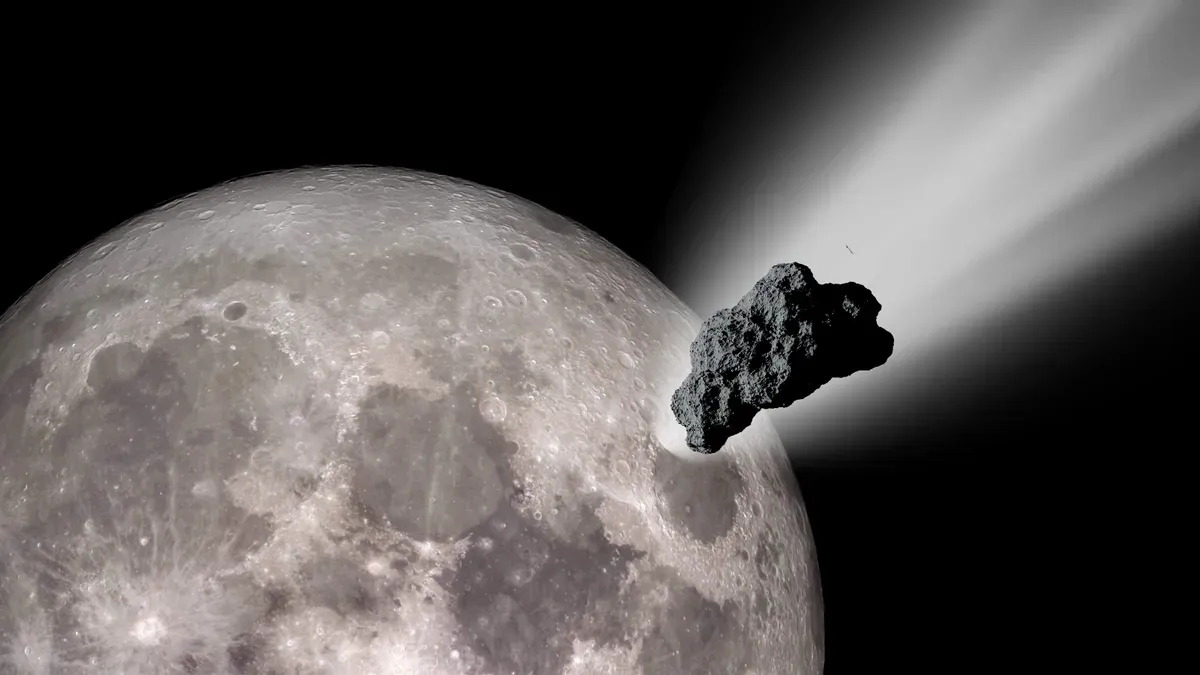
A 4.2-billion-year-old asteroid impact may have reshaped the moon's interior, leaving its near and far sides geologically distinct. Analysis of basaltic rock samples collected by China's Chang'e 6 mission from the South Pole–Aitken Basin revealed a higher ratio of potassium-41 to potassium-39 compared to near-side Apollo samples and lunar meteorites.
The findings, published in Proceedings of the National Academy of Sciences on January 12, 2025, suggest the anomaly originated from an impact event that vaporized lighter isotopes under extreme heat and pressure.
Heng-Ci Tian's team at the Chinese Academy of Sciences ruled out cosmic ray irradiation, magma processes, and meteoritic contamination as causes for the isotopic anomaly.
They concluded the impact reduced volatile elements in the far-side mantle, limiting magma formation and explaining the scarcity of lunar maria on the far side.
The study's authors acknowledge the lack of direct observational data on the impact's magnitude, noting that "the scale of the event remains constrained by indirect modeling."
By contrast, alternative hypotheses proposing mantle convection or tidal heating as drivers of lunar asymmetry were tested but found insufficient to explain the potassium isotope ratios.
The team emphasizes that while the impact hypothesis aligns with existing geological models, further analysis of deep mantle samples could refine the timeline and mechanics of the event.