



Twelve thousand years ago, before the Bronze Age civilizations of Mesopotamia, people in what is now Wyoming were already casting marked objects and watching how they fell. The oldest known dice in the Americas come from Folsom deposits across Wyoming, Colorado, and New Mexico, dating to the end of the last Ice Age. They predate the earliest Old World probability tools by roughly 6,000 years.
Archaeologist John Madden developed a four-part test to identify these artifacts: they must be two-sided, readily distinguishable by color or marking, fit one of four shape categories, and be small enough to cast by hand.
Applying these criteria, he confirmed 565 Native American dice from 45 sites and flagged 94 more as probable examples. Objects with drilled holes or shape-only distinctions were excluded, as they could be beads or ornaments instead.
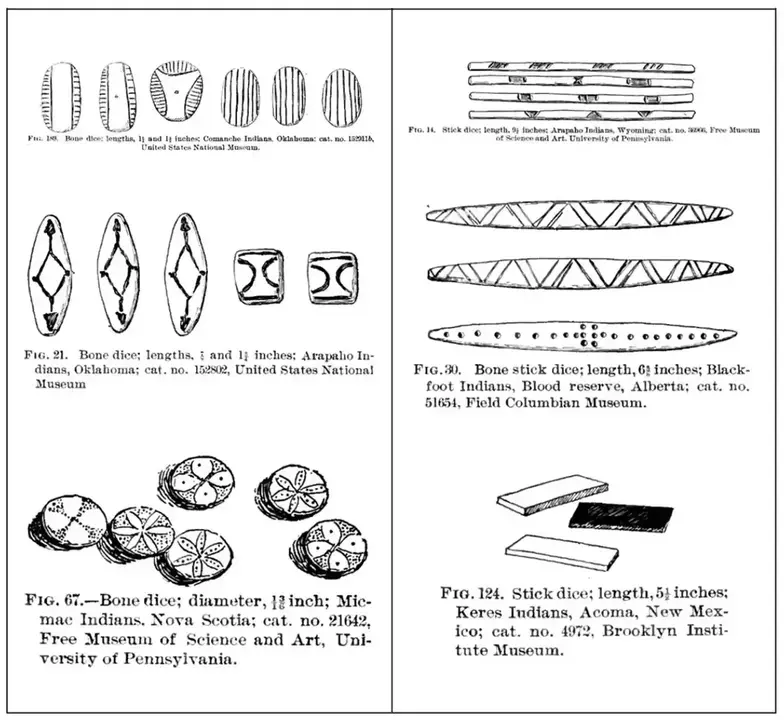
The scale of earlier documentation hints at how much material was waiting to be recognized. In 1907, ethnographer Robert Stewart Culin published an 809-page report on North American games, drawn from 14 years of fieldwork with tribes introduced by anthropologist George A. Dorsey. Culin catalogued 239 sets of dice from 130 tribes. Madden's framework let him return to excavated collections and see what had already been found but not understood.
These were not games of house advantage. They were one-on-one exchanges between people who rarely met, a mechanism for building relationships through repeated fair play rather than single transactions.
The deeper implication concerns how humans began to think about chance itself. The Old World origin of probabilistic thinking, tied to Bronze Age dice and divination, has long been treated as the starting point for mathematical probability.
John Madden:
"When we see the origins of dice, we're literally seeing the origins of probabilistic thinking. That's always been thought to have begun in the Old World, in the Bronze Age, about 6,000 years ago. This research shows that Native Americans were making dice, generating random outcomes and using those random streams of probability and harnessing them in games of chance 6,000 years earlier. So, if we want to understand the history of probabilistic thinking, we now need to look into the Old World at the end of the last Ice Age."
Madden is careful about what this does not mean. The findings do not claim that Ice Age hunter-gatherers were doing formal probability theory. But they were intentionally creating, observing, and relying on random outcomes in repeatable, rule-based ways that leveraged probabilistic regularities, such as the law of large numbers.
The study leaves open whether similar practices existed elsewhere in the New World during this period, or whether the knowledge was transmitted or independently developed across the continent.
American Antiquity, 2026. DOI: 10.1017/aaq.2025.10158 | Thanks Arstechnica