


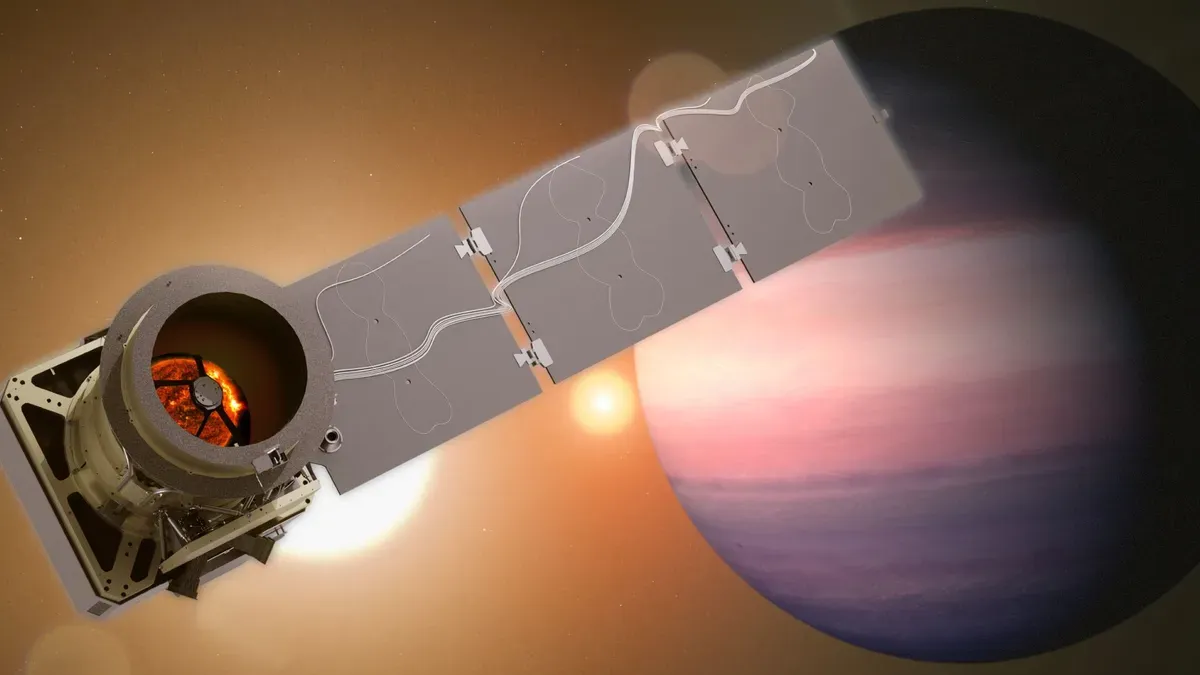
SpaceX is scheduled to launch NASA's Pandora satellite on January 11, 2024, from Vandenberg Space Force Base. The mission aims to enhance the analysis of exoplanet atmospheres by addressing complexities arising from stellar surface variability.
Pandora will utilize a 45-cm telescope to study 20 exoplanets through transit spectroscopy, a method that measures changes in a star's brightness and spectral characteristics as a planet passes in front of it.
"Pandora aims to disentangle the star and planet spectra by monitoring the brightness of the exoplanet's host star in visible light while simultaneously collecting infrared data."
Transit spectroscopy involves observing the light from a star as it filters through an exoplanet's atmosphere during a transit. Variations in the star's surface—such as sunspots or magnetic activity—can distort the spectral data, complicating the identification of atmospheric components.
By collecting data in both visible and infrared wavelengths, Pandora seeks to isolate planetary signals from stellar noise, a critical step in accurately characterizing exoplanet atmospheres.
The Falcon 9 rocket carrying Pandora will use a first stage that has launched four times previously. The rideshare mission includes 40 payloads, such as 10 Kepler Communications' Aether satellites and two Capella Space's Acadia radar satellites. This launch aligns with NASA's broader goals to refine techniques for atmospheric analysis, which are essential for future missions seeking to identify potentially habitable worlds.