


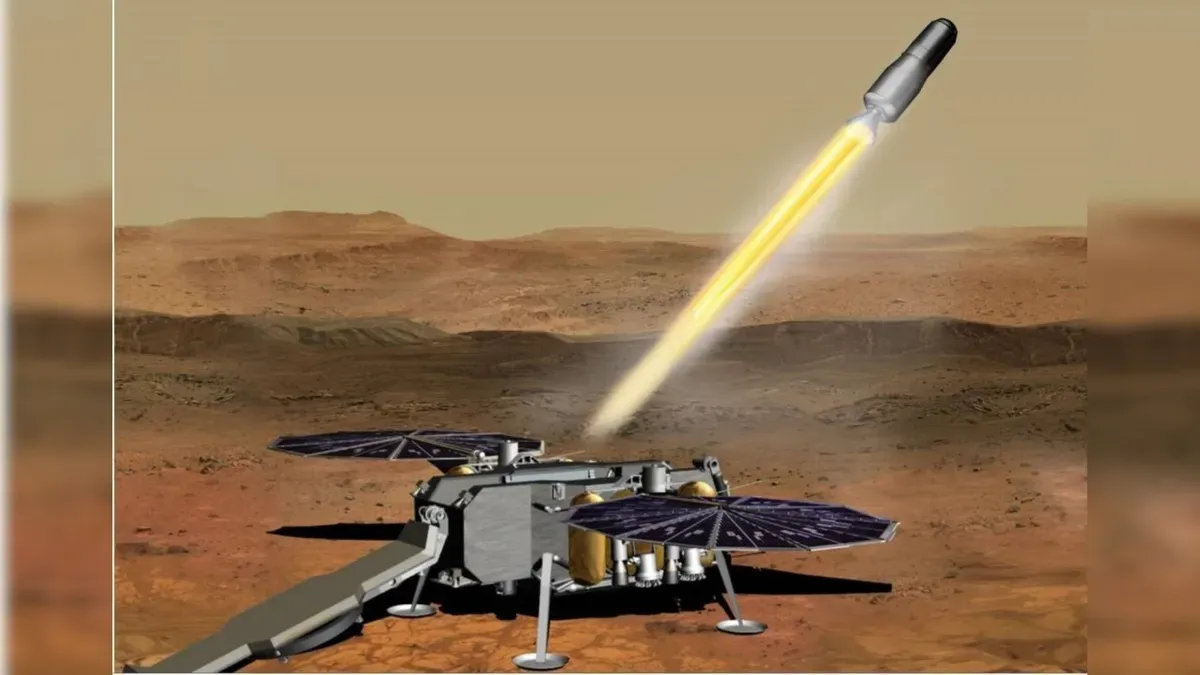
The U.S. House of Representatives has voted to terminate NASA's Mars Sample Return program, a decision that could delay critical scientific progress on ancient Martian life and undermine U.S. leadership in deep space exploration.
The FY2026 minibus bill allocates $24.4 billion to NASA, with $7.25 billion designated for the Science Mission Directorate, but explicitly cancels the $11 billion MSR initiative.
This move has prompted warnings from the scientific community about lost opportunities to analyze Martian samples collected by the Perseverance rover since 2021.
Victoria Hamilton, chair of the Mars Exploration Program Analysis Group (MEPAG), described the potential cancellation as a critical setback: 'We are on the cusp of finally determining whether there was life on ancient Mars... It would be devastating to America's and NASA's reputation if the U.S. is forced to sit on the sidelines.
The MEPAG statement emphasized that the MSR program represents 'a once-in-a-generation opportunity to address fundamental questions about Mars' habitability and the potential for life beyond Earth.
The bill mandates a new 'Mars Future Missions' program line, requiring NASA to develop shared technological heritage for robotic and crewed missions.
While this directive preserves some Mars exploration funding, it diverges from the MSR's specific goal of retrieving samples from Jezero Crater.
The distinction between the canceled program and the new initiative has raised concerns about fragmented mission priorities and delayed scientific returns.
The Planetary Society, in a statement, noted that the abrupt termination of MSR risks not only scientific knowledge but also geopolitical standing in space exploration.
The organization highlighted that the Perseverance rover has already collected rock, regolith, and atmospheric samples—material that could provide definitive evidence of past Martian biosignatures if returned to Earth for analysis.