


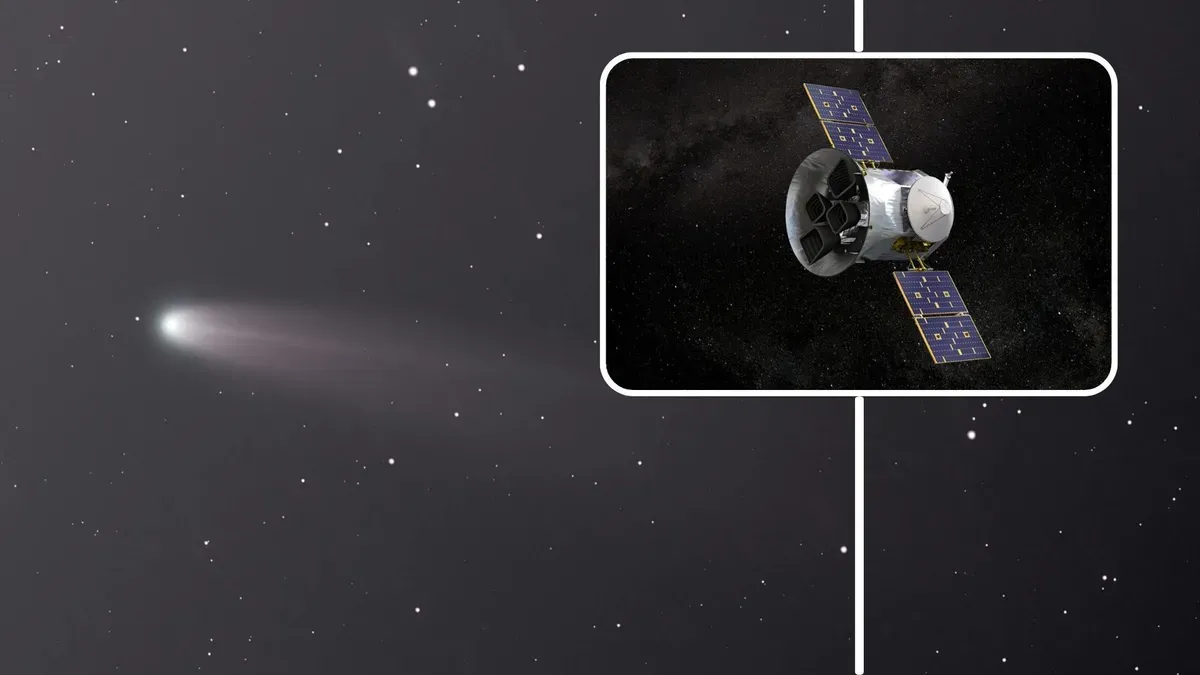
NASA's exoplanet hunter TESS has turned its gaze to a cosmic interloper, capturing fleeting glimpses of interstellar comet 3I/ATLAS as it departs our solar system.
The Transiting Exoplanet Survey Satellite (TESS) observed the comet from Jan. 15 to Jan. 22, 2025, tracking its trajectory as a bright, fast-moving object with a faint tail. Its wide-field design enabled these observations despite TESS's primary focus on exoplanet detection via the transit method.
TESS recorded the comet at an apparent magnitude of 11.5, 100 times fainter than naked-eye visibility. Data from May 2025 revealed the comet's presence two months before its official discovery, allowing retroactive tracking of its path.
A 28-hour video compiled by MIT's Daniel Muthukrishna shows the comet's motion, though observations were interrupted by a TESS 'safe mode' event related to solar panel issues.
"The dataset provides a unique opportunity to study rotational dynamics and activity cycles in the comet's core," noted researchers analyzing the Mikulski Archive for Space Telescopes (MAST) data. The publicly available dataset may yield insights into the comet's behavior as it exits the solar system.
The scientific community has not reached consensus on the comet's interstellar origin, as the dataset does not resolve its provenance.
TESS's incidental comet observations highlight the value of wide-field instruments in capturing transient celestial events.