


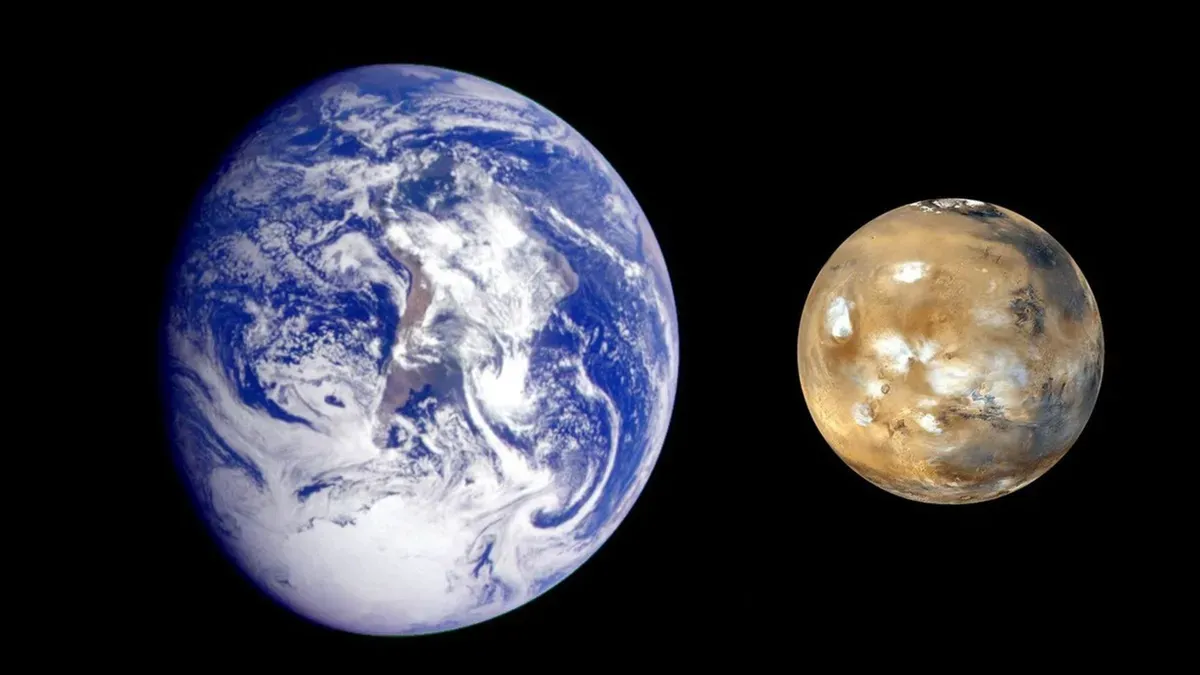
Removing Mars from the solar system in simulations erased two of Earth's longest climate cycles, revealing the red planet's outsized role in shaping our planet's geological history.
A study published in Publications of the Astronomical Society of the Pacific (Dec. 18, 2023) quantified Mars's gravitational influence on Earth's Milankovitch cycles for the first time. These cycles—100,000-year and 2.4-million-year periods—disappeared entirely when Mars was excluded from the simulations.
Milankovitch cycles describe periodic changes in Earth's orbit and axial tilt that drive long-term climate shifts.
The three primary components are eccentricity (changes in orbital shape), obliquity (axial tilt variations between 21.5° and 24.5° over 41,000 years), and precession of the equinoxes (wobble in Earth's rotational axis).
While the moon has traditionally been credited with stabilizing obliquity, this study suggests Mars's gravity also plays a critical role in maintaining axial tilt stability.
"When you remove Mars, those cycles vanish," said Stephen Kane, University of California, Riverside.
Mars's position farther from the sun amplifies its gravitational effect on Earth compared to closer planets like Venus and Jupiter. The 430,000-year eccentricity cycle, however, remains unaffected by Mars's absence, as it is primarily influenced by Venus and Jupiter's combined gravitational forces.
The findings challenge assumptions about Earth's climate regulation and have implications for exoplanet habitability.
Outer planets may similarly stabilize climate cycles in Earth-like worlds, potentially extending habitable conditions over longer timescales. The study's methodology relied on numerical simulations modeling planetary gravitational interactions over millions of years, isolating Mars's contribution by systematically removing it from the system.