


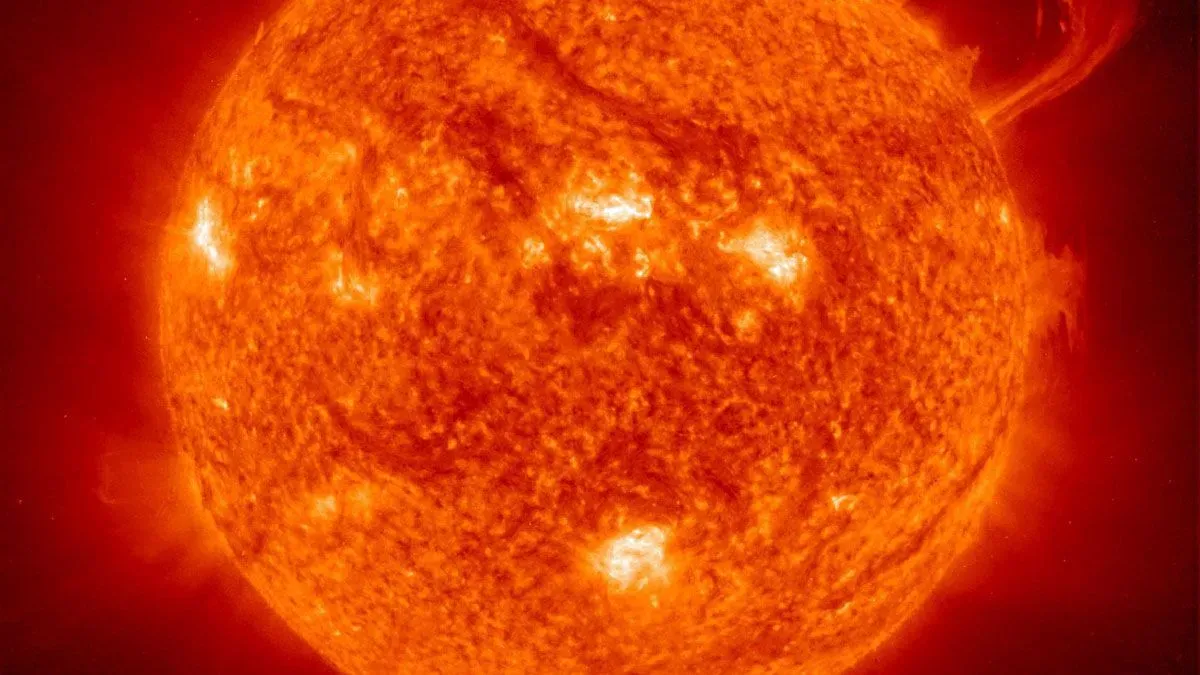
A magnetic avalanche on the sun powered a solar flare, revealing new insights into solar energy release mechanisms. A solar flare observed on September 30, 2024, was powered by an avalanche of smaller magnetic reconnection events, per ESA's Solar Orbiter mission.
ESA co-Project Scientist Miho Janvier called it one of the most exciting results from Solar Orbiter so far.
Lead author Pradeep Chitta noted the spacecraft's position at 27 million miles allowed unprecedented observation of the flare's 40-minute evolution. Four instruments—EUI, SPICE, STIX, and PHI—captured magnetic field instability and plasma dynamics at sub-2-second intervals.
The flare accelerated particles to 40–50% of light speed, producing coronal mass ejections with implications for space weather prediction.
This study challenges existing theories by demonstrating that single flares can result from cascading smaller reconnection events, not isolated eruptions.
Published in Astronomy & Astrophysics on January 21, 2025, the findings raise open questions about whether this mechanism applies to other stars, including red dwarfs.