


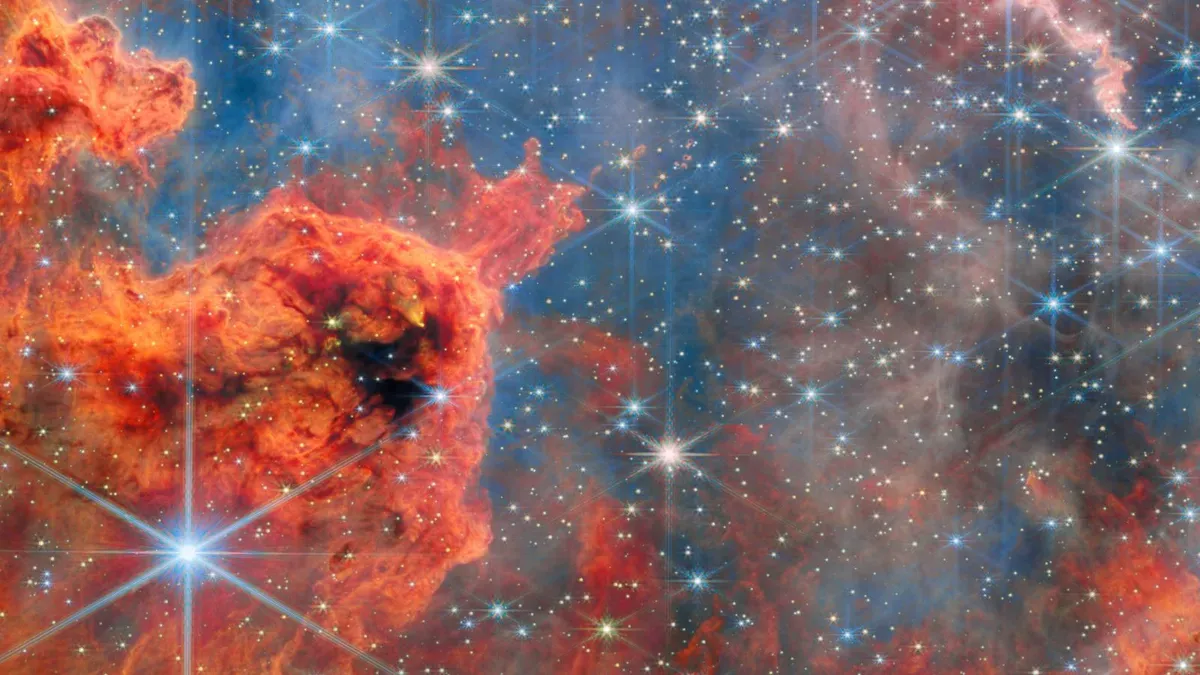
The James Webb Space Telescope (JWST) has captured the first complete census of brown dwarfs in the Westerlund 2 star cluster, a dense stellar nursery located 20,000 light-years from Earth.
The observations, conducted in the Carina Nebula, identified objects as small as 10 Jupiter masses, providing a clearer picture of star formation in environments dominated by intense radiation.
Westerlund 2, spanning 6-13 light-years, resides within the Gum 29 stellar nursery. Its extreme conditions—characterized by high-energy radiation from massive stars—pose challenges for the formation of low-mass objects like brown dwarfs.
These objects, often described as failed stars, lack the mass to sustain hydrogen fusion, the process that powers true stars. The JWST’s ability to detect faint members of the cluster offers a unique opportunity to study how such objects form and survive in hostile environments.
By analyzing the population of brown dwarfs in Westerlund 2, researchers can compare star-forming efficiency in extreme regions to more tranquil stellar nurseries.
This comparison may refine models of stellar birth rates and the distribution of mass in young clusters. However, the findings remain preliminary, requiring further observations to confirm trends and assess their broader implications for astrophysical theory.