


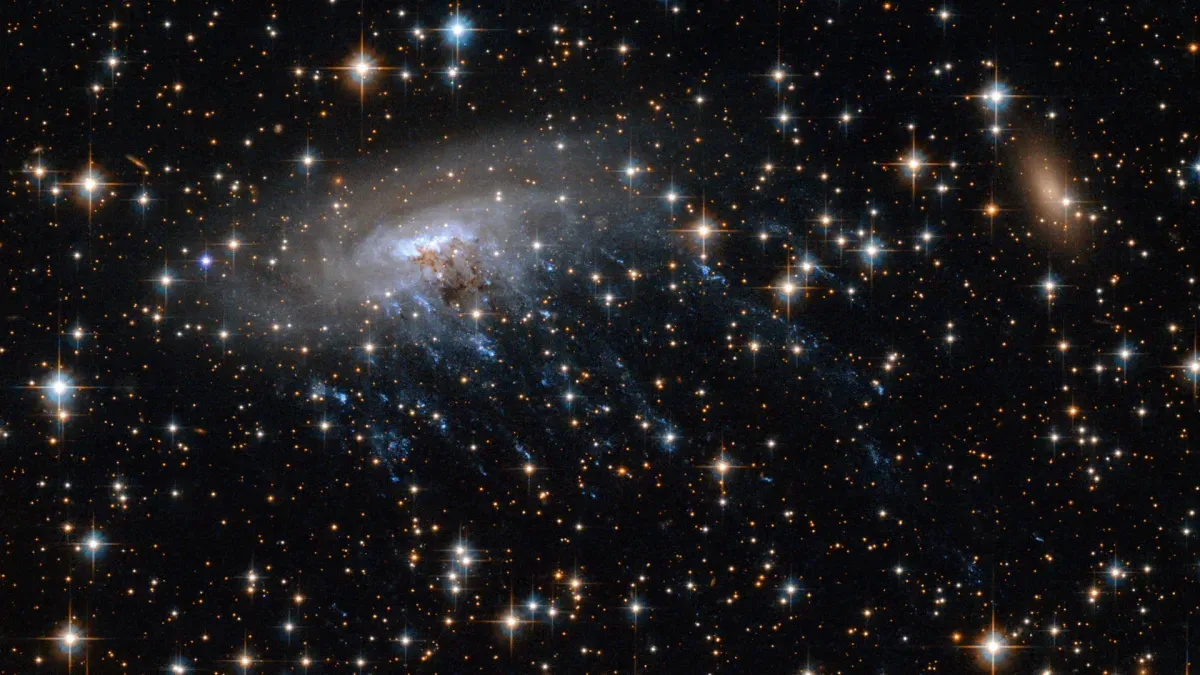
The James Webb Space Telescope has identified a jellyfish galaxy at redshift z = 1.156, 8.5 billion light-years from Earth, revealing star-forming tentacles shaped by ram-pressure stripping in a dense galaxy cluster.
The study, published in a peer-reviewed journal, utilized JWST’s COSMOS field analysis to map gas streams and star-forming knots, challenging assumptions about the early universe’s tranquility.
Ram-pressure stripping occurs when a galaxy moves through a cluster’s hot gas, compressing and elongating its interstellar medium.
Dr. Ian Roberts of the University of Waterloo noted, “The first is that cluster environments were already harsh enough to strip galaxies, and the second is that galaxy clusters may strongly alter galaxy properties earlier than expected.” This finding suggests galaxy clusters in the early universe were dynamically active, accelerating star formation in stripped gas.
The team plans follow-up JWST observations to confirm the mechanism and quantify star formation rates in the stripped material. Current models predict such processes in modern clusters, but this discovery pushes the timeline back by billions of years.
Researchers emphasize the need for larger datasets to determine if this galaxy is an outlier or representative of broader trends in early cosmic evolution.
Source: University of Waterloo | Sciencedaily