


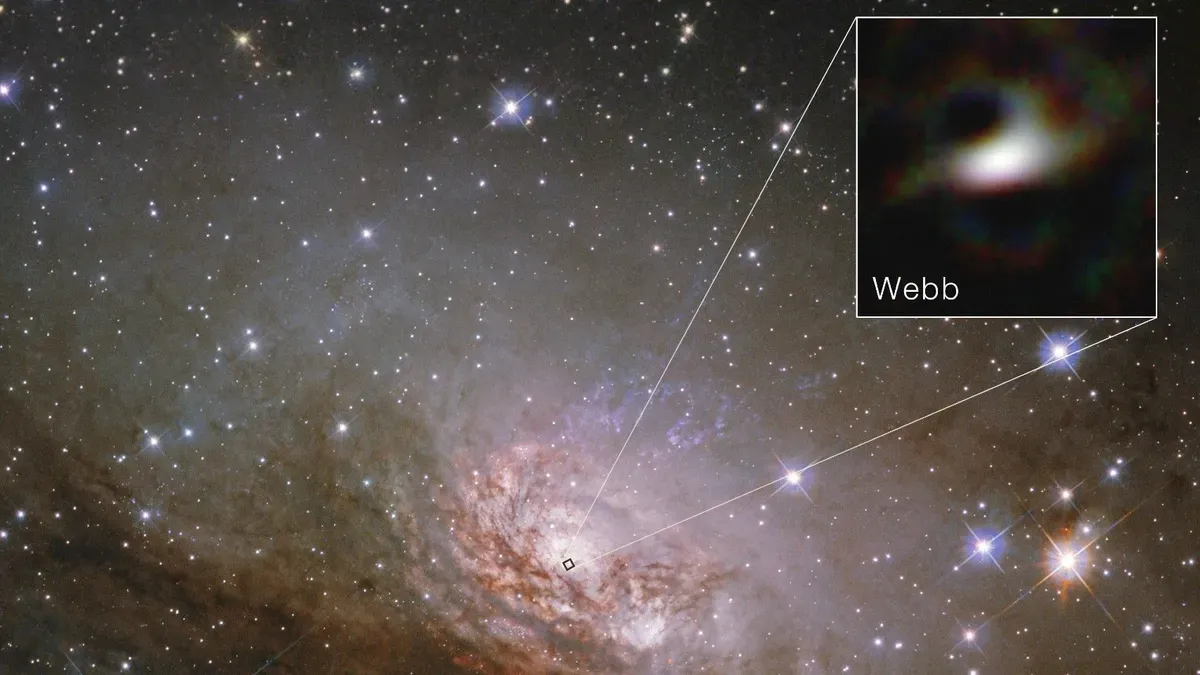
The James Webb Space Telescope has resolved a decades-old mystery about the origin of infrared emissions near supermassive black holes, revealing that 87% of the excess radiation originates from the accretion disk rather than outflows as previously assumed.
Using its aperture masking interferometer (AMI), the telescope achieved twice the resolution of earlier observations, enabling detailed imaging of a 33-light-year-wide region around the black hole in the Circinus galaxy.
"This allows us to see images twice as sharp," said Joel Sanchez-Bermudez, an astrophysicist at the National University of Mexico. The study, published in Nature Communications, challenges long-standing models of black hole dynamics and underscores the role of accretion disks in shaping galactic environments.
An accretion disk is a rotating structure of gas and dust that spirals into a black hole, heating up and emitting radiation in the process.
The AMI technique, part of JWST's NIRISS instrument, overcomes atmospheric interference to capture high-resolution data. Lead author Enrique Lopez-Rodriguez noted that these findings could refine models of supermassive black hole behavior and their influence on host galaxies.
However, the team acknowledges limitations in the current dataset and calls for further observations to confirm the broader applicability of these results.
The study does not address whether these findings will impact models of star formation suppression, as the authors explicitly avoided making such claims.
The research team emphasized that while the AMI method is powerful, it remains a specialized tool requiring careful calibration for different astrophysical targets.