


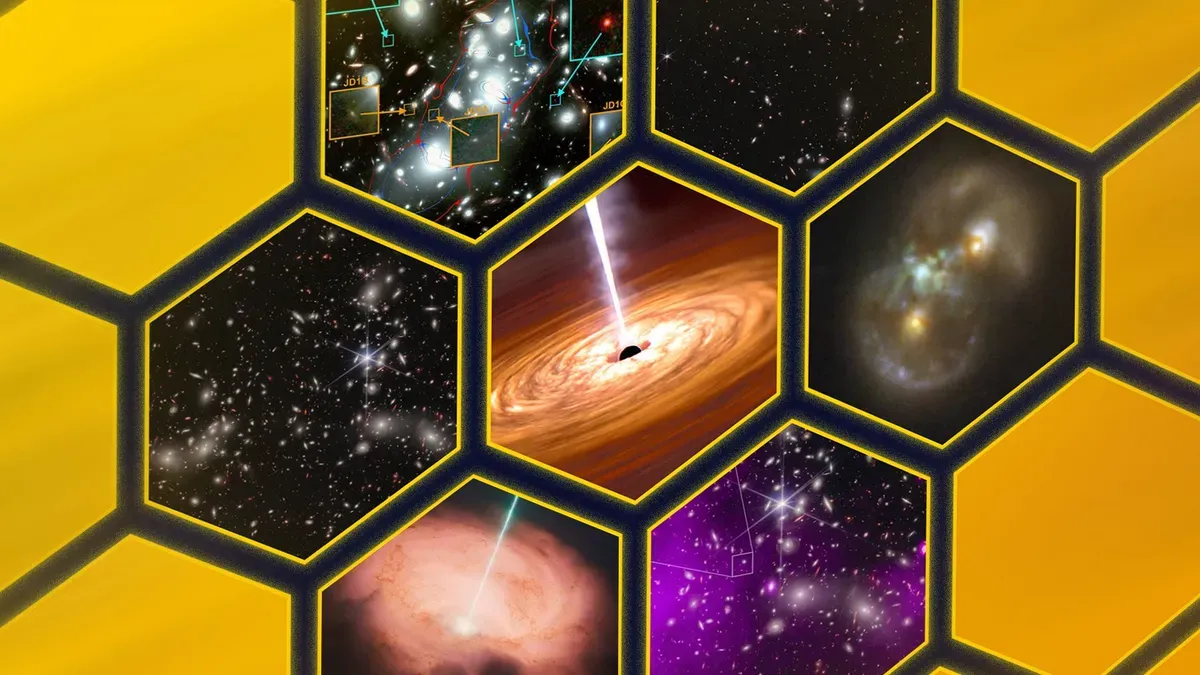
The James Webb Space Telescope is rewriting the cosmic history of supermassive black holes, revealing giants that defy conventional formation timelines. Observations of UHZ1—a galaxy hosting a 40 million solar mass black hole when the universe was 470 years old—and QSO1, a 50 million solar mass black hole from 700 million years post-Big Bang, show no visible host galaxies.
These findings, described as 'one of the most exciting phases of my career... a real revolution in our understanding' by University of Cambridge's Roberto Maiolino, challenge existing models of black hole formation.
The 'little red dots' phenomenon, where massive black holes appear without associated galaxies, contradicts prior assumptions. JWST's infrared and X-ray data—such as UHZ1's similar brightness in both spectra—support direct-collapse models, which propose black holes forming from gas clouds without stars.
'We still don't see where the host galaxy is,' notes Lukas Furtak of the University of Texas at Austin, highlighting the unresolved mystery of these objects' origins.
Theoretical frameworks include direct-collapse black holes (1,000–1 million solar masses), primordial black holes from the Big Bang era, and post-Big Bang, pre-star formation models.
While JWST data aligns with direct-collapse scenarios, uncertainties remain about the mechanisms that allowed such massive objects to form so rapidly. Future missions like Euclid and Nancy Grace Roman will provide higher-resolution data to distinguish between competing hypotheses.