


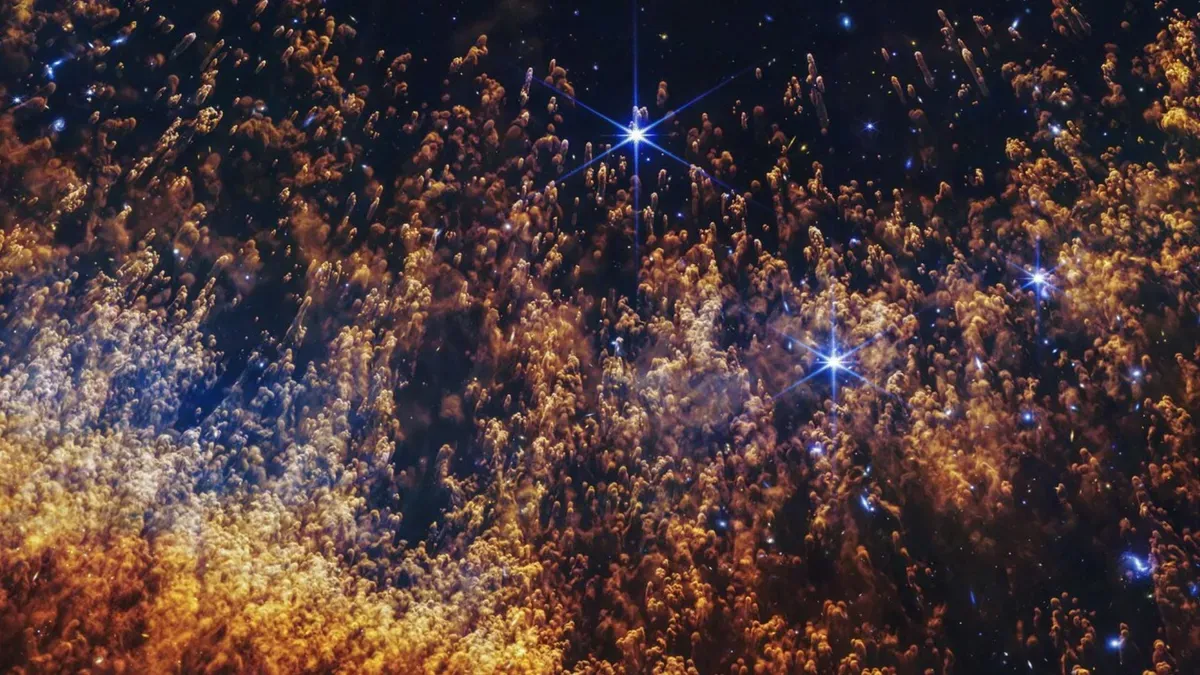
The James Webb Space Telescope has captured a detailed infrared image of the Helix Nebula (NGC 7293), revealing the final stages of a sunlike star's life cycle.
The observation, taken on Jan. 20, 2026, using the telescope's Near-Infrared Camera, shows the nebula located 655 light-years away in the constellation Aquarius. NASA describes planetary nebulas as clouds of hydrogen, helium, and cosmic dust ejected by dying stars, with the central white dwarf's radiation ionizing the surrounding gas.
The image highlights cometary knots—structures formed as high-speed stellar winds interact with older gas layers. These features appear as distinct shapes within the nebula, with molecular hydrogen visible in yellow and dust in red.
NASA states that the star's former outer layers are seeding the galaxy with carbon, oxygen, and nitrogen, elements essential for life on Earth. The agency emphasizes that such nebulas act as 'cosmic recycling centers,' redistributing materials for future stellar and planetary formation.
Planetary nebulas result from stars similar to the sun shedding their outer layers during the red giant phase. The central white dwarf, a dense remnant of the star's core, emits ultraviolet radiation that ionizes the ejected gas, creating the nebula's luminous appearance.
While the sun's future evolution into a red giant and eventual white dwarf is a well-established astrophysical model, NASA explicitly notes that the timeline for such processes remains subject to ongoing research.
"Within this colorful scene, a vital process is unfolding: A star's former outer layers... are seeding the galaxy with carbon, oxygen and nitrogen — the same elements that make life on Earth possible," states the NASA description of the image.
The Helix Nebula serves as a template for understanding stellar death cycles. Observations like these contribute to refining models of how stars enrich interstellar space with chemical elements. However, the precise mechanisms governing the distribution of these materials remain areas of active investigation.