ISS Image Reveals Earth's Airglow and the Large Magellanic Cloud
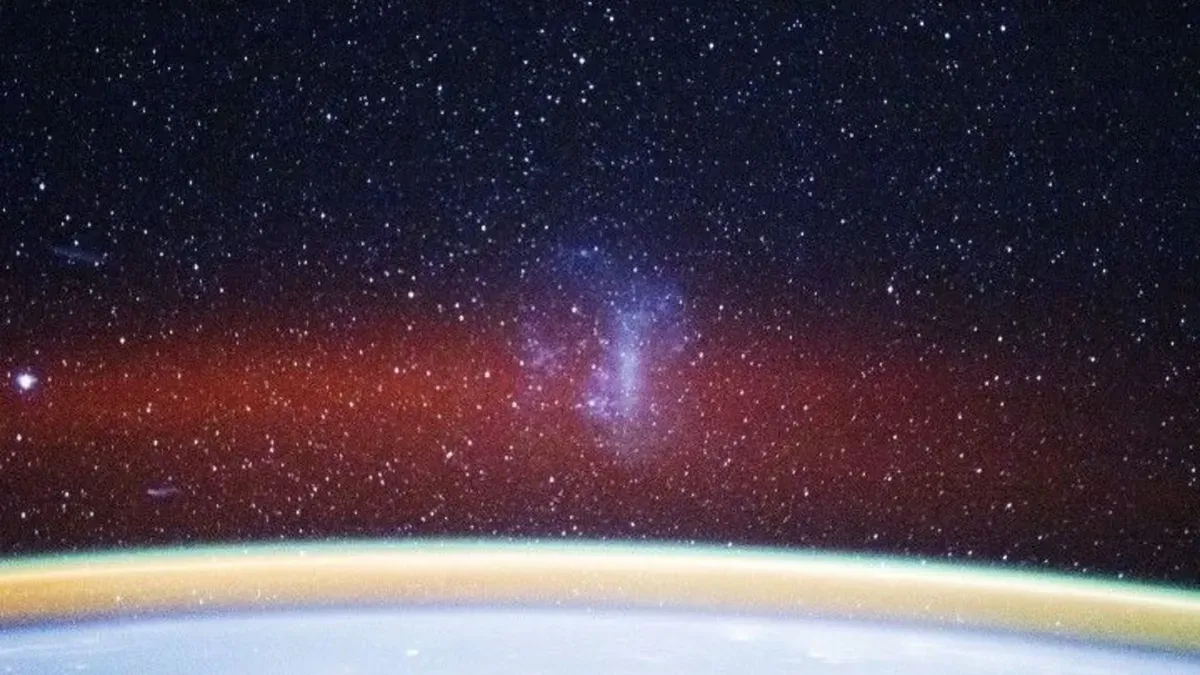
From the vantage point of the International Space Station, astronauts recently captured a striking image merging the luminous edge of Earth's atmosphere with a distant galaxy.
The image, taken on Nov. 28, 2025, combines Earth's airglow—a faint emission caused by energy released from atmospheric atoms and molecules after sunlight and chemical reactions—with the Large Magellanic Cloud (LMC), a satellite galaxy located 160,000 light-years from Earth.
The photograph was captured using a Nikon Z9 camera equipped with a 50-millimeter lens. The ISS's orbital altitude of 248 miles (400 kilometers) provides a vantage point above much of Earth's atmospheric interference, enabling clearer observations of both atmospheric phenomena and deep-space objects compared to ground-based facilities.
Researchers describe the LMC as a "natural laboratory" for studying star formation and supernova remnants, including the well-documented Supernova 1987A, which has offered insights into supernova dynamics and dust formation over decades.
"This camera is ideal for astrophotographers wanting quality, reliable and high-resolution stills of celestial objects," according to the manufacturer.
The image highlights the interplay between Earth's atmospheric processes and the distant stellar activity of the LMC, offering a rare composite view of planetary and galactic-scale phenomena.