India's PSLV Rocket Returns to Flight with Hyperspectral Military Satellite and 15 Other Payloads
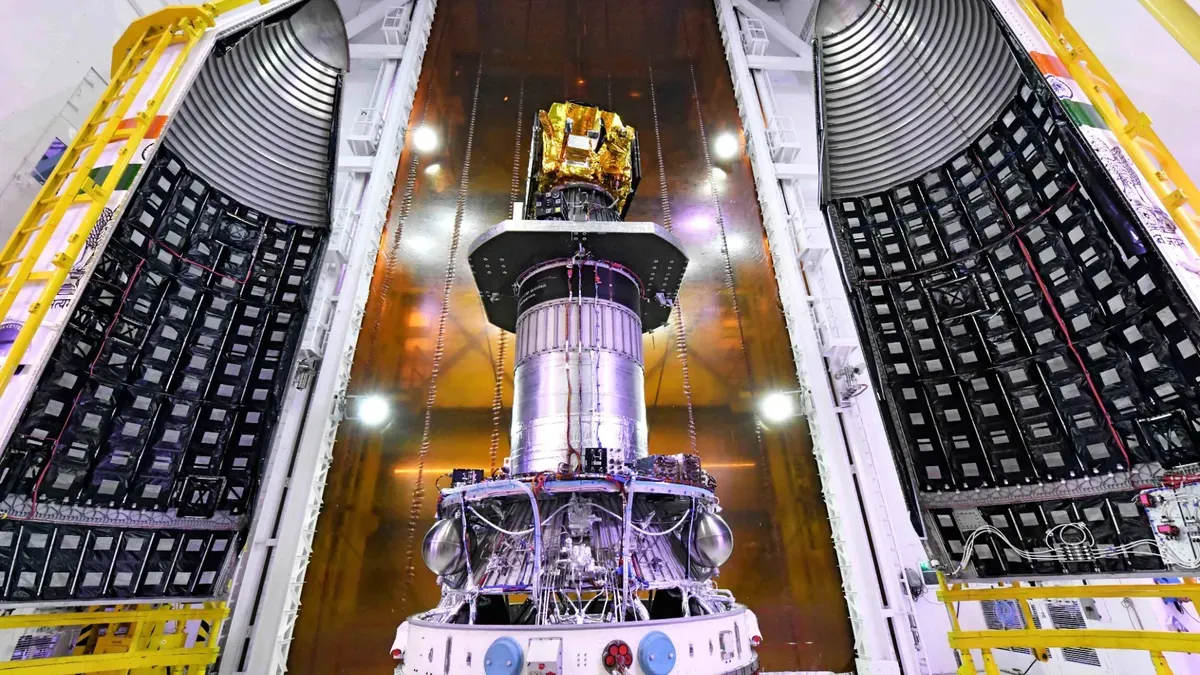
India's Polar Satellite Launch Vehicle (PSLV) resumes its flight program on January 12, carrying a military Earth-observation satellite and 15 other payloads.
The launch from Satish Dhawan Space Centre at 10:17 a.m. IST marks the rocket's return after a May 2025 failure that destroyed the EOS-09 satellite. With 63 prior launches and a 3.2% failure rate (3 failures, 60 successes), the PSLV remains a workhorse of India's space program.
The primary payload, EOS-N1 (Anvesha), is a hyperspectral imaging satellite designed to scan Earth's surface continuously.
According to The Tribune, the satellite will "generate valuable intelligence" through its advanced imaging capabilities. India has an active program to develop a fleet of military satellites for surveillance and communication, though specific technical details about EOS-N1's resolution or spectral bands remain unconfirmed by ISRO.
Secondary payloads include a Thai-U.K. Earth-observer, a Brazilian maritime aid satellite, an in-orbit fueling test, and the Spanish KID reentry capsule.
The KID capsule, scheduled to splashdown in the South Pacific, represents a novel technology demonstration for controlled reentry systems. ISRO has not disclosed whether this experiment will inform future capsule designs for crewed missions or cargo recovery.
The May 2025 failure, which occurred during the EOS-09 launch, marked the PSLV's third and most recent setback. While ISRO has not publicly detailed the root cause of the anomaly, the agency's 96.8% success rate over 63 launches demonstrates the rocket's overall reliability.
The current mission will test whether recent modifications to the PSLV's four-stage design—featuring solid-fueled first and third stages, liquid-fueled second stage, and a solid-fueled fourth stage—have addressed any systemic issues.
Third-party analyses suggest the military applications of EOS-N1 could extend beyond intelligence gathering.
The Tribune reported that the satellite's hyperspectral imaging may support border monitoring and infrastructure assessment, though ISRO has not officially confirmed these uses.
The KID capsule's reentry trajectory will be monitored by international tracking networks to assess its aerodynamic performance during descent.