


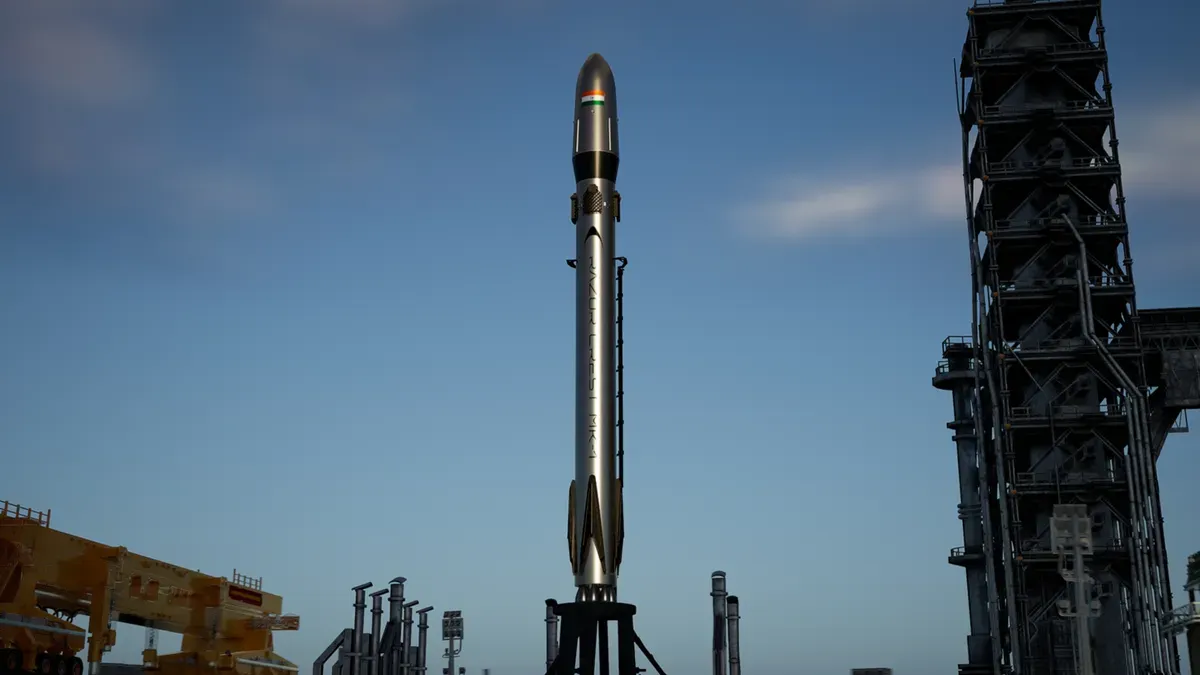
An Indian space startup’s $80M valuation leap reveals how rocket science is becoming a game of financial engineering as much as propulsion engineering.
EtherealX, which recently closed a $20.5M Series A at $80.5M valuation, is betting on a fully reusable launch vehicle to disrupt the $420 billion global space economy.
The company’s 2027 demo flight target hinges on engine testing of its Pegasus upper-stage and Stallion booster engines, with hot-fire tests scheduled for 2025.
For mid-sized satellite operators evaluating EtherealX’s $350-$2,000/kg pricing model against SpaceX’s Falcon 9 costs, the technical tradeoffs are stark.
EtherealX’s 8-ton payload capacity—compared to Falcon 9’s 24.8-ton capacity—requires a 150% increase in launch frequency to match throughput. However, the startup’s 323-second specific impulse (Isp) for its Pegasus engine outperforms Falcon 9’s 306-second Isp, suggesting better fuel efficiency.
This efficiency could offset the smaller payload size for operators prioritizing cost-per-kilogram over total mass delivery.
The operational risk calculus shifts with engine clustering. EtherealX’s 15x Pegasus engine array versus SpaceX’s 9x Stallion design introduces complexity in thrust management and failure tolerance.
While more engines can enhance redundancy, they also multiply potential failure points during ascent. The 150-acre manufacturing campus opening in 2026 will need to scale production of these clustered systems without compromising reliability—a challenge given the startup’s current 67-person workforce planning to grow to 90 by 2025.
With $130M in launch memorandums of understanding already secured from SpaceBD and TASA, EtherealX’s financial engineering strategy is clear: capture niche markets where Falcon 9’s economies of scale don’t apply.
The question remains whether its technical execution can match the ambition encoded in its valuation.