Hubble Observes Protostar Dynamics in NGC-1333's Stellar Nursery
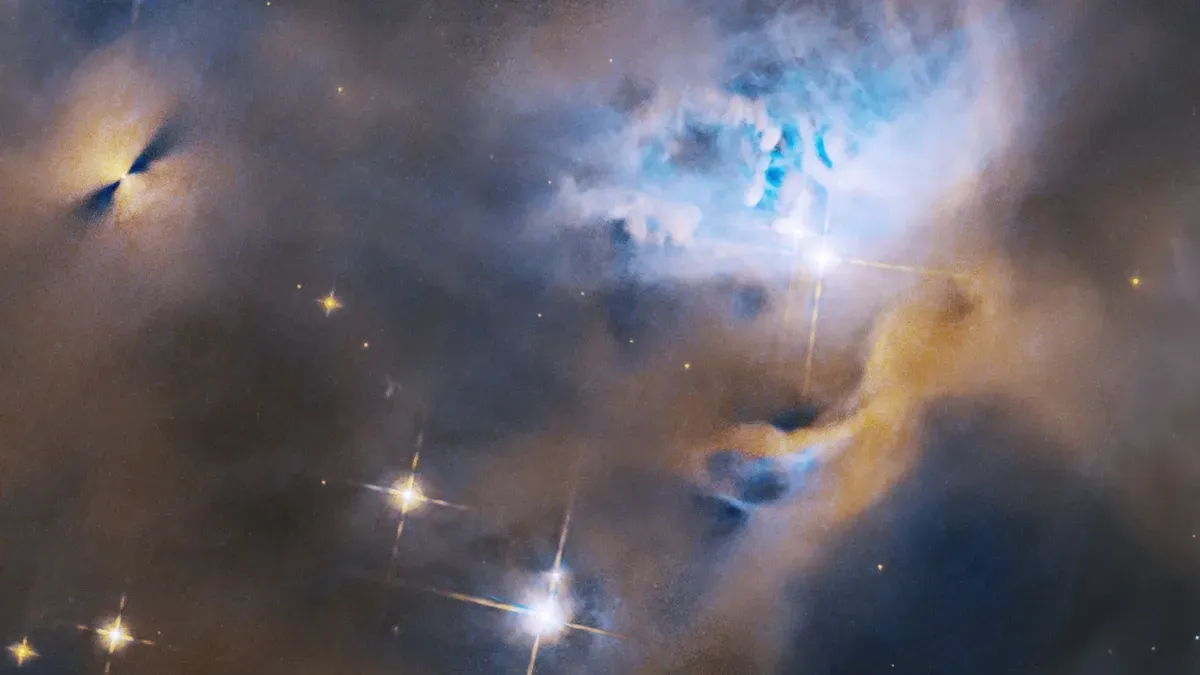
NASA's Hubble Space Telescope has captured an image of a young protostar in the NGC-1333 star-forming region, revealing dynamic processes of star formation. The observation focuses on a protostar within the Perseus molecular cloud, located 950 light-years from Earth.
The image shows a protoplanetary disk surrounding the protostar, with outflows creating reflection nebulae. Hubble researchers described the visible stripes in the image as 'the signature of a protoplanetary disk and the disk's shadow cast across the larger envelope of material that still surrounds the young star.'
NGC-1333 serves as a critical site for studying episodic star formation. Recent analyses have examined protostellar jet outbursts as 'time stamps' for tracking evolutionary stages. The region's dynamics illustrate how stars shape their environments, influencing the formation of future planetary systems.
A reflection nebula is defined as a cloud of interstellar dust that reflects light from nearby stars, while a protoplanetary disk is a rotating structure of dense gas and dust surrounding a young star, where planets may eventually form.
The Hubble data align with existing theories about star formation but emphasize the need for further observations to clarify how outflows and disks interact in shaping stellar nurseries.
Researchers caution that while the current findings provide insight into early stellar development, the precise mechanisms governing these processes remain under investigation.