


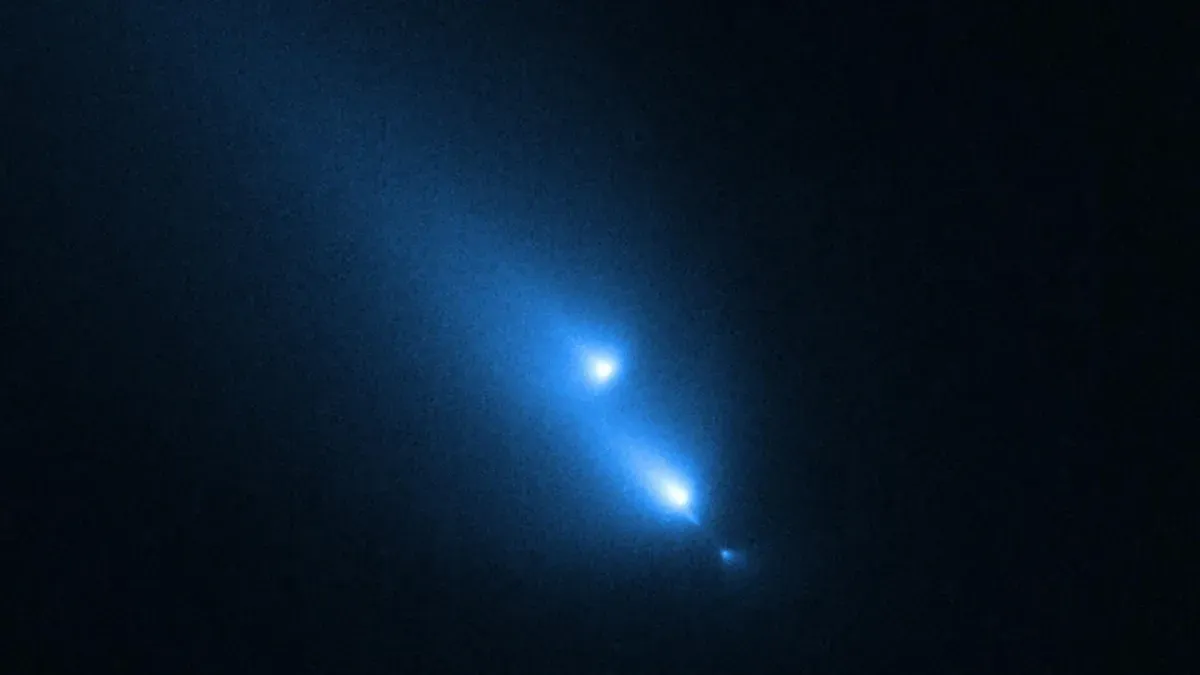
A routine Hubble pivot to a backup target accidentally froze a comet’s death throes in the act. On 8–10 November 2025 the telescope imaged comet C/2025 K1 (ATLAS) as it fractured into at least four distinct nuclei, roughly eight days after the breakup began.
The comet, about 5 miles across and 250 million miles from Earth in the constellation Pisces, had already slipped back toward the outer solar system following a close pass inside Mercury’s orbit one month earlier.
Hubble’s 20-second exposures resolved each fragment wrapped in its own coma, a level of detail impossible from the ground where the pieces appeared as a single smear of light.
Co-investigator John Noonan of Auburn University recalled that while scanning the first frames he realized “there were four comets in those images when we only proposed to look at one.” The timing of the exposures, captured while the observatory re-pointed for an unrelated program, let the team reconstruct the fragmentation sequence almost hour-by-hour.
A brightness lag added a puzzle: the nuclei separated days before Earth-based monitors recorded a surge in total light.
Researchers suspect that buried ices took time to sublimate through newly exposed dust layers, a delay that could refine models of how cometary material weathers near the Sun. Early spectra from Hubble’s STIS and COS instruments already hint at unusually low carbon abundance; full analysis is pending.
C/2025 K1 is a long-period comet on a hyperbolic trajectory and will not return. The findings appear in Icarus (DOI: 10.1016/j.icarus.2026.116996).
Source: Sciencedaily