Giant Cosmic 'Sandwich' Reveals Largest Observed Protoplanetary Disk Structure
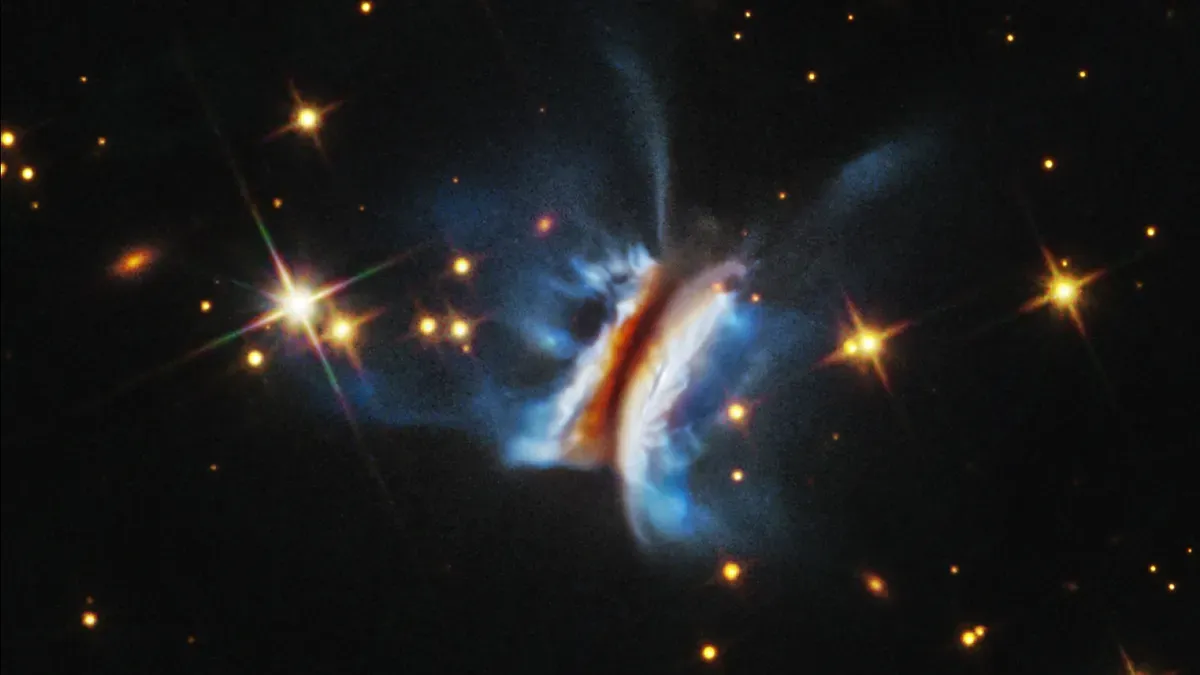
A cosmic 'sandwich' named 'Dracula's Chivito' has become the largest known planetary nursery, challenging assumptions about protoplanetary disk symmetry and activity.
The object, IRAS 23077+6707, is a protoplanetary disk located 978 light-years away in the constellation Cepheus. Measuring 400 billion miles in diameter—over 100 times the scale of Earth's orbital system—it was first identified in 2016 and confirmed via Hubble Space Telescope imaging in 2026.
The disk's edge-on orientation reveals asymmetric vertical filaments on one side and a sharp edge on the other. This structural anomaly complicates direct observation of the central stellar system, which is likely a single massive star or binary pair.
Kristina Monsch of the Center for Astrophysics noted, 'The level of detail we're seeing is rare in protoplanetary disk imaging.' Joshua Bennett Lovell, co-investigator, added, 'Hubble has given us a front row seat to chaotic planetary formation processes.'
The Hubble's role in imaging edge-on systems is critical, as its high-resolution optics capture fine-scale features that ground-based telescopes cannot resolve. The disk's tilted orientation, while challenging for direct observation, provides unique insights into the dynamics of material distribution and potential planet formation mechanisms.
Observational data indicate the disk could form a vast planetary system, though this remains speculative without further evidence.
The nickname 'Dracula's Chivito' originated from a Transylvanian-Uruguayan collaboration, though cultural references are not elaborated in the study.
The team emphasizes that the disk's morphology—particularly its asymmetric vertical filaments and sharp edge—requires refinement in existing planet formation models. Monsch described the structure as 'a natural laboratory for studying how disks evolve under extreme conditions.'