


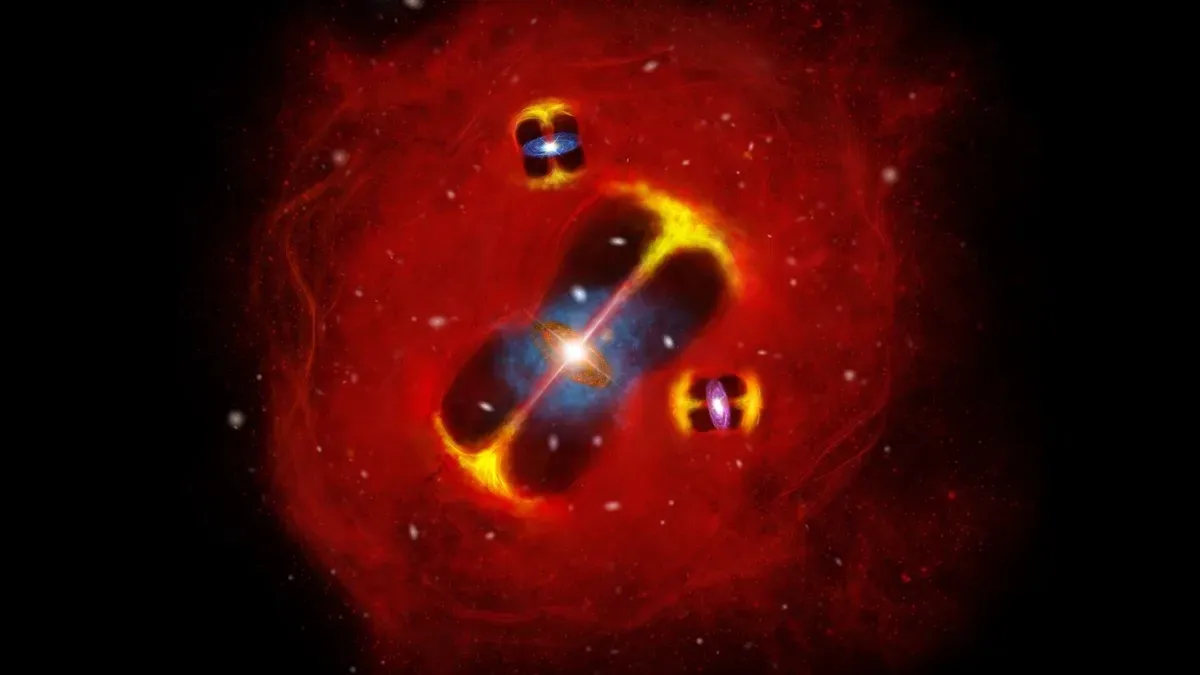
Astronomers have uncovered a galaxy cluster in the early universe that defies all known rules of cosmic evolution. The compact cluster, SPT2349-56, contains over 30 galaxies within 500,000 light-years and was observed 1.4 billion years after the Big Bang.
Its intracluster medium—a diffuse plasma filling the space between galaxies—is at least five times hotter than theoretical predictions, with no known mechanism to explain such rapid heating.
Scott Chapman of Dalhousie University described the findings as evidence that "something in the early universe, likely three recently discovered supermassive black holes in the cluster, were already pumping huge amounts of energy into the surroundings and shaping the young cluster, much earlier and more strongly than we thought." Dazhi Zhou of the University of British Columbia added, "We didn't expect to see such a hot cluster atmosphere so early in cosmic history."
The temperature was measured via the Sunyaev–Zeldovich effect, a phenomenon where high-energy electrons in the intracluster medium scatter cosmic microwave background photons, altering their energy.
This method confirms electron-driven energy transfer but highlights a contradiction with existing models of cluster formation. Unlike earlier "protoclusters" such as z660D, SPT2349-56 is gravitationally bound, suggesting current models of galaxy cluster evolution are incomplete.
Member galaxies in SPT2349-56 exhibit a star formation rate 5,000 times faster than in the Milky Way, correlating with supermassive black hole activity and extreme gas heating.
The findings, published in Nature on Jan. 5, 2024, challenge assumptions about the timeline and mechanisms of cosmic structure formation. The team notes that further observations are required to determine whether such clusters are rare anomalies or indicative of broader revisions to cosmological theory.