


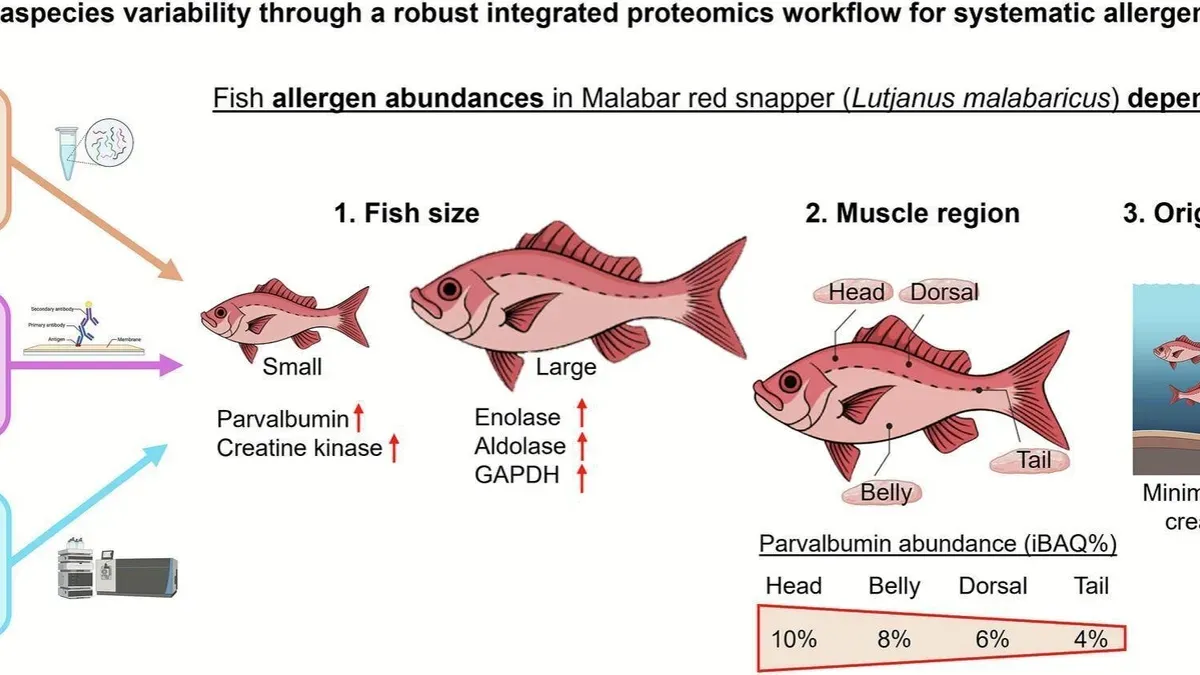
Fish allergy risks depend on more than just species—size and which part you eat matter significantly, according to new research. A study analyzing 39 Malabar red snappers found that allergen profiles varied across fish sizes, body regions, and production origins.
Smaller fish contained higher concentrations of major allergens like parvalbumin and creatine kinase, while larger specimens showed elevated levels of heat-labile allergens. The head region of the fish contained more than twice the allergen content of the tail, suggesting anatomical location influences risk.
Researchers employed protein separation techniques, antibody assays, and mass spectrometry to quantify allergen distribution. The findings revealed no significant differences between farmed and wild-caught fish but emphasized the importance of considering fish size and body region in risk assessments. Dr. Thimo Ruethers noted:
"Results showed protein profiles varied markedly by fish size and muscle region, but not between farmed or wild-caught fish."
Prof. Andreas Lopata added that the study provides a framework for systematic allergy risk evaluation. He suggested that future risk assessments and mitigation strategies should incorporate fish size and body region alongside species and product type.
The study does not provide clinical guidance and was limited to a single species, with the authors cautioning that results may not generalize to all fish.
The research was published in Food Chemistry (DOI: 10.1016/j.foodchem.2026.147950) and analyzed a sample of 39 Malabar red snappers. Key numerical outcomes included the head region’s allergen levels being more than twice those in the tail. The study’s limitation—focusing on a single species—highlights the need for broader investigations to validate these findings across different fish types.
⚠️ LEGAL DISCLAIMER: It is for informational purposes only. It never substitutes for professional medical advice, diagnosis, or treatment. Always consult your doctor regarding any questions about your health.