


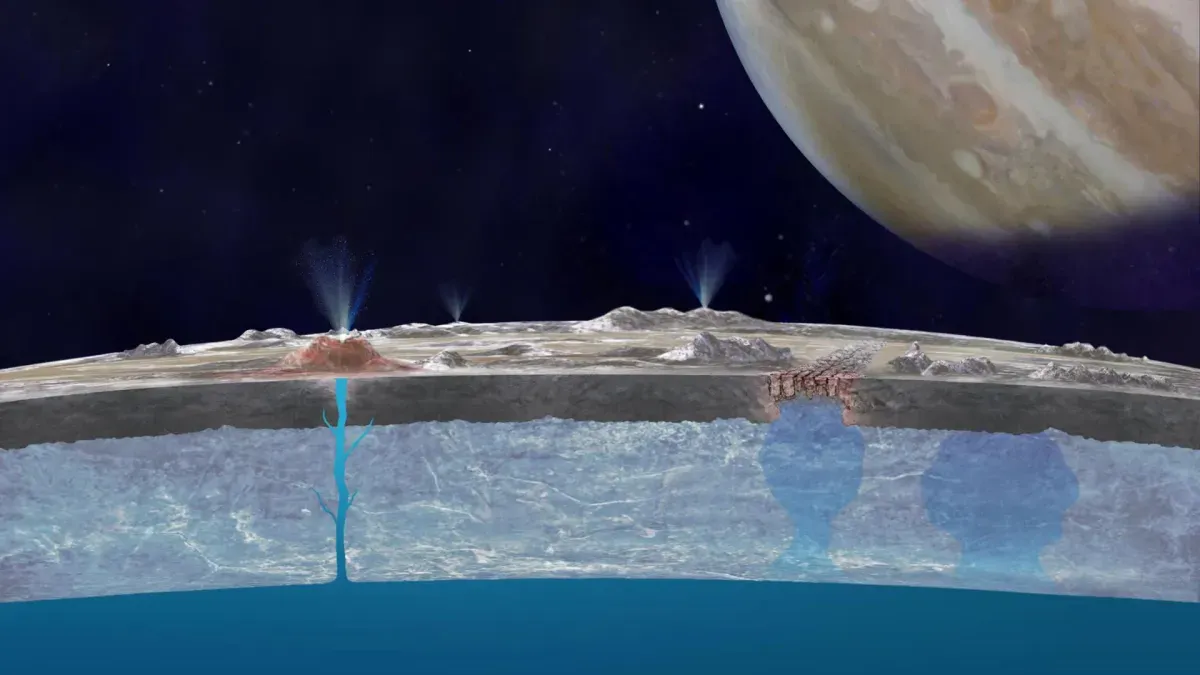
New modeling of Jupiter's icy moon Europa suggests its subsurface ocean may lack the geological activity necessary to sustain life. A study led by Paul Byrne at Washington University challenges long-held assumptions about the moon's dynamic seafloor.
The research, published in Nature Communications in January 2026, indicates that tidal forces on Europa are insufficient to generate the heat required for active geological processes such as seafloor volcanism or hydrothermal plumes.
"If we could explore that ocean with a remote-control submarine, we predict we wouldn't see any new fractures, active volcanoes, or plumes of hot water on the seafloor," the authors argue.
Europa's ice shell is estimated to be 15-25 kilometers thick, with an underlying ocean potentially reaching 100 kilometers in depth. These measurements contrast sharply with those of Jupiter's volcanic moon Io, where intense tidal heating drives extreme geological activity.
While Io experiences tidal forces strong enough to melt rock and create active volcanoes, Europa's weaker tidal interactions limit internal heat generation.
The findings raise questions about the moon's habitability, particularly regarding the availability of chemical energy sources that could support life.
NASA's Europa Clipper mission, scheduled for launch in 2031, aims to directly measure the thickness of Europa's ice shell and characterize its ocean properties. However, the study emphasizes that current evidence does not confirm the presence of active geological processes beneath the ice.