


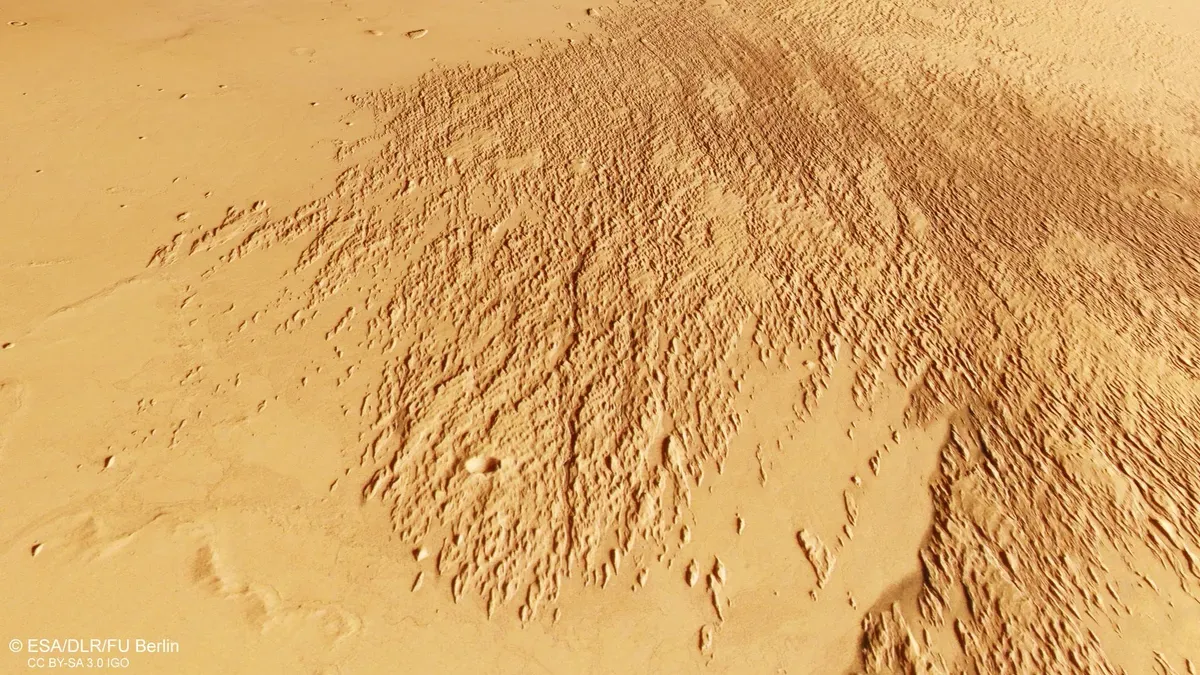
ESA's Mars Express orbiter has captured a 3D map of wind-eroded yardangs near Eumenides Dorsum, providing insight into Martian atmospheric dynamics.
The High Resolution Stereo Camera (HRSC) imaged an area nearly the size of Belgium at the northern end of Eumenides Dorsum, part of the Medusae Fossae Formation.
This region, adjacent to the Tharsis volcanic province, contains yardangs that formed on lava-rafted terrain, indicating a geological sequence of volcanic resurfacing followed by sustained wind erosion.
"The ridges all lean the same way, slanting and curving in from the lower left of the frame, which ESA noted reflects the direction of the prevailing wind in this region."
The yardangs' orientation serves as a geological compass, recording the direction of ancient Martian winds. The Medusae Fossae Formation's dust-rich composition makes it particularly susceptible to erosion, preserving these wind-sculpted features over time.
The HRSC's decades-long mapping of Mars in color and 3D has enabled such detailed analysis of surface processes.
While the findings confirm established models of Martian aeolian activity, the precise timing of wind events and their relationship to climate shifts remain areas requiring further investigation.
Additional data from future missions may refine understanding of how these features evolved alongside Mars' atmospheric changes.