EHT Reveals Twisted Jet Dynamics in Distant Black Hole System OJ287
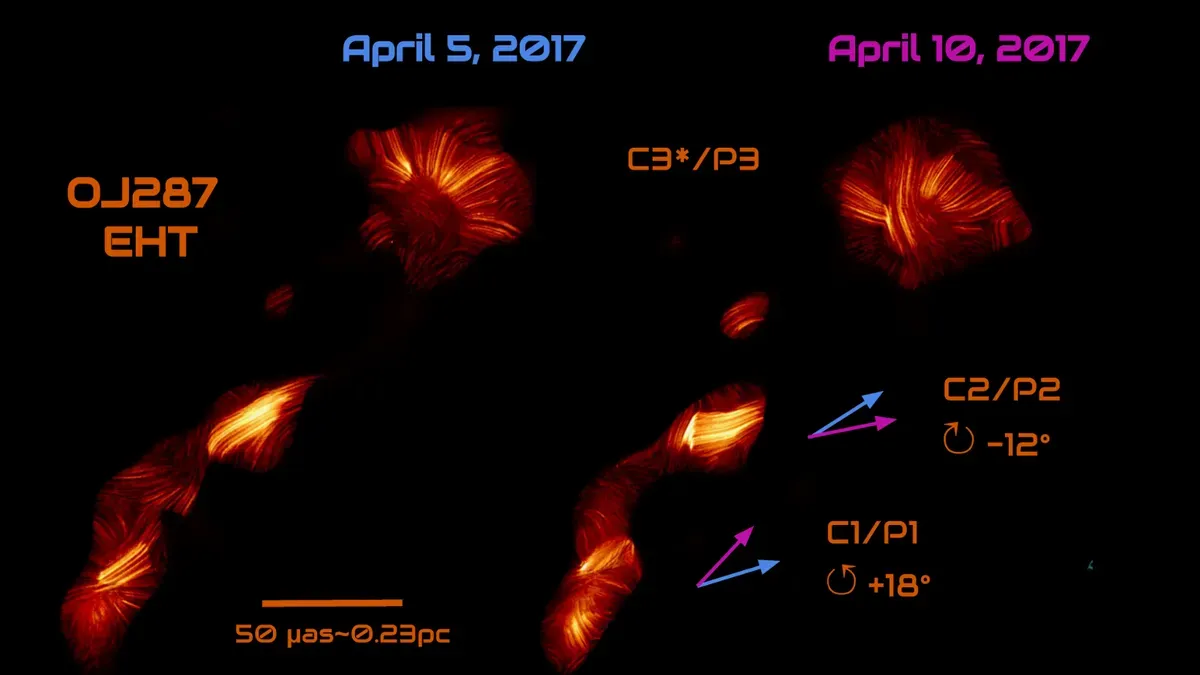
Astronomers have captured the twisted magnetic dance of a black hole jet, revealing never-before-seen interactions between shockwaves and instabilities in OJ287’s cosmic core.
Using the Event Horizon Telescope (EHT), the team observed a quasar 1.6 billion light-years from Earth, where two shockwaves travel at different speeds within a jet, interacting with Kelvin-Helmholtz instabilities—fluid dynamic phenomena that occur when velocity differences across fluid interfaces create wave-like patterns.
These interactions generate a helical magnetic field structure, as documented in a study published in Astronomy & Astrophysics on Jan. 8.
The observations captured structural and polarization changes in the jet over five days, the shortest interval ever recorded for black hole jet variability.
This rapid evolution challenges existing models of jet behavior, particularly the precession hypothesis, which posits that jet direction changes due to orbital motion. "Our observations indicate non-ballistic motions of these components, calling into question the precession hypothesis," stated Rocco Lico, one of the study’s contributors.
Mariafelicia De Laurentis emphasized the broader implications: "This result shows that the EHT is not only useful for producing spectacular images, but can also be used to understand the physics that govern black hole jets."
Ilje Cho added, "We are spatially resolving the individual shock components and observing their interaction with Kelvin-Helmholtz instabilities." The five-day benchmark provides a critical reference for future studies of jet dynamics and magnetic field evolution.