Early Barred Spiral Galaxy Confirmed 11.5 Billion Light-Years Away
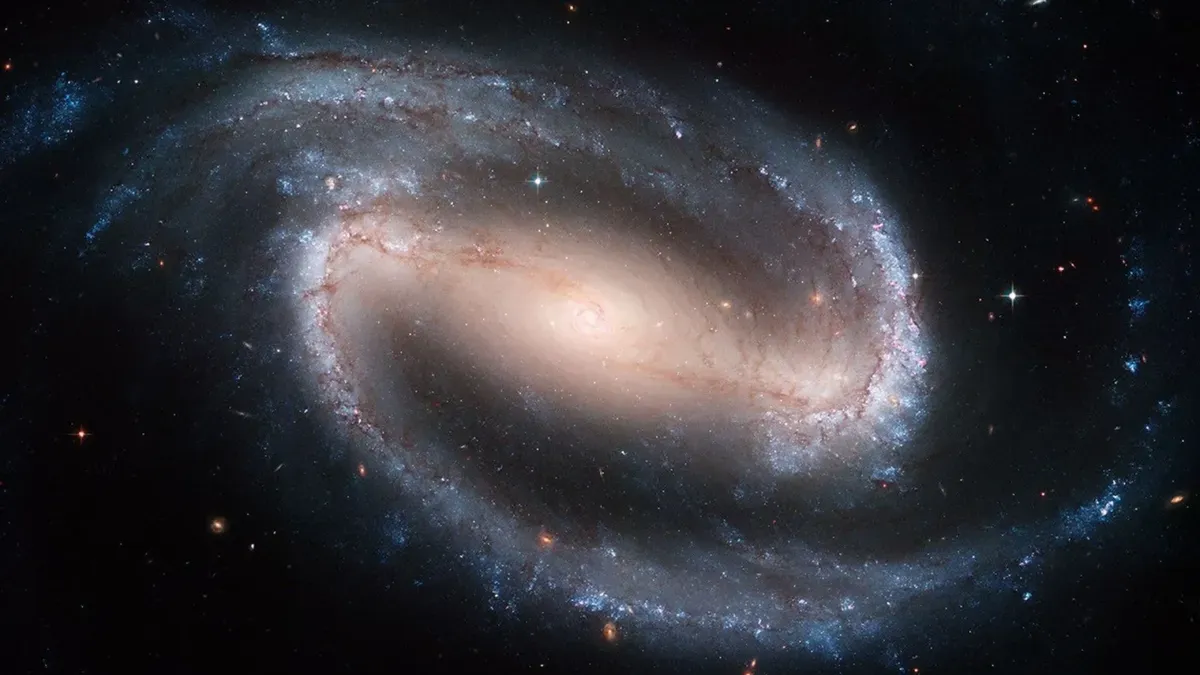
Astronomers have identified the earliest confirmed Milky Way-like barred spiral galaxy, observed just 2 billion years after the Big Bang, challenging assumptions about galactic evolution timelines.
The galaxy COSMOS-74706, located 11.5 billion light-years away, was spectroscopically validated using the James Webb Space Telescope (JWST) and Keck I's MOSFIRE spectrograph.
This discovery refines models of bar formation in galaxies by demonstrating that such structures can emerge earlier than previously theorized.
"This galaxy was developing bars 2 billion years after the birth of the Universe... In principle, I think that this is not an epoch in which you expect to find many of these objects.
It helps to constrain the timescales of bar formation," the researchers noted. Unlike prior candidates that relied on gravitational lensing or redshift—methods with inherent uncertainties—spectroscopy provided precise validation of COSMOS-74706's morphology and redshift.
Barred spiral galaxies like the Milky Way are critical for funneling gas toward central black holes, a process essential to galactic dynamics.
The study, presented at the 247th American Astronomical Society meeting in Phoenix, Arizona, highlights the limitations of earlier observational techniques.
Gravitational lensing distorts light, while redshift measurements carry 10-15% uncertainty, making spectroscopy a more reliable method for confirming such distant structures.
The team emphasized that this finding does not speculate on future implications but instead focuses on refining current models.
"The scientific community has not reached consensus on these features," they caution, noting that further observations will be required to determine if COSMOS-74706 represents an isolated case or a broader trend in early galactic evolution.