Dragon Capsule Returns with ISS Research, Upcoming Cargo Missions Set for March
A SpaceX Dragon spacecraft concluded its six-month science mission at the International Space Station on August 29, 2025, returning to Earth with over 3,000 pounds of research experiments and hardware.
The capsule’s departure marks the end of a critical phase of microgravity research, including studies on cardiac function, semiconductor crystal growth, and AI-assisted documentation systems.
Following the Dragon’s return, JAXA’s HTV-X1 cargo vehicle is scheduled to depart the ISS in early March 2025. Unlike the Dragon’s controlled reentry, the HTV-X1 will remain in orbit for several weeks to conduct orbital testing of advanced antenna and solar cell technologies.
Dragon returns to Earth packed with science for analysis. Two more cargo craft are due to depart in March as Exp 74 wraps up the week with space biology and advanced tech. https://t.co/BWY9zpL78K
— International Space Station (@Space_Station) February 27, 2026
During this period, the spacecraft will deploy multiple CubeSats for independent scientific and technological experiments.
Northrop Grumman’s Cygnus XL, slated for release shortly after HTV-X1, will undergo a controlled atmospheric reentry. This mission is designed to evaluate the spacecraft’s structural integrity during reentry and to safely dispose of non-essential cargo.
The distinction between HTV-X1’s orbital testing and Cygnus XL’s destructive reentry reflects differing operational priorities for cargo vehicles post-mission.
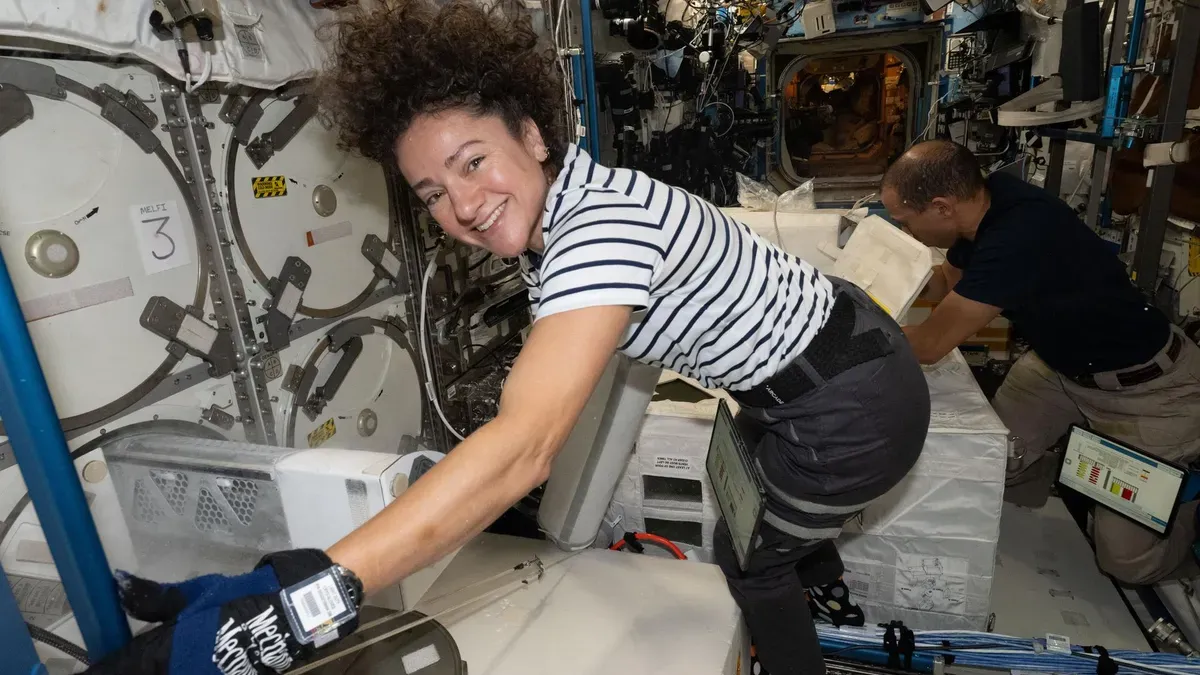
Crew activities during the Dragon’s mission included cardiac monitoring to assess long-duration spaceflight effects, experiments on semiconductor crystal growth under microgravity conditions, and treadmill-based fitness tests to evaluate muscle atrophy mitigation strategies.
Researchers also tested an AI-assisted speech-to-text system for documenting experiments in low-gravity environments.