


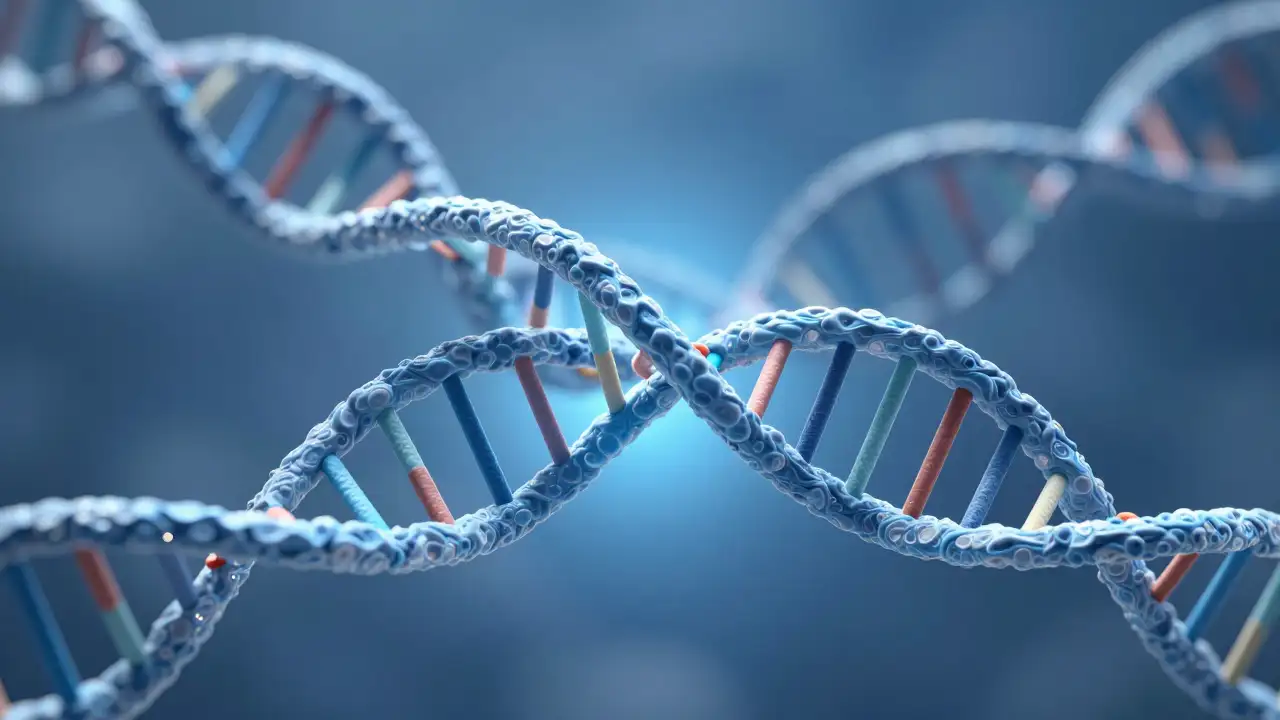
A synthetic DNA system can distinguish cancer cells from healthy ones by requiring two separate molecular signals before releasing its payload, functioning like a miniature computer inside the body.
Researchers at the University of Geneva built the technology from short DNA strands far smaller than antibody-based drugs. Their size allows deeper penetration into tumor tissue, and their programmable nature enables precise control over when and where drugs activate.
The mechanism relies on what the team calls a "two-key" system. Separate DNA strands carry different functions: some recognize cancer markers on cell surfaces, while another carries a toxic drug. When two distinct markers appear together on a cell, the DNA components attach and assemble at that exact location. This triggers a hybridization chain reaction that builds more DNA structures at the site, amplifying drug delivery. If either marker is missing, nothing happens. The drug stays inactive.
The process mirrors two-factor authentication. Both markers must be present. This "and" logic gate ensures the treatment activates only under specific conditions, making it highly selective.
In laboratory experiments, the system successfully identified cancer cells bearing specific combinations of surface proteins and delivered potent drugs directly to them. Nearby healthy cells remained unaffected. The researchers also demonstrated that multiple drugs can be delivered simultaneously, a feature that could help prevent or overcome drug resistance.
Nicolas Winssinger, full professor in the Department of Organic Chemistry at UNIGE and last author of the study:
"This could mark an important step forward in the evolution of medicine, with the introduction of a self-operating drug system. Until now, computers and AI have helped us design new drugs. What's new here is that the drug itself can, in a simple way, 'compute' and respond intelligently to biological signals."
The technology represents a shift from simply designing drugs with computer assistance to creating drugs that perform computation themselves. The system uses basic logic operations — "and," "or," "not" — at the molecular level to make decisions about activation.
Antibody-drug conjugates, the current standard for targeted cancer therapy, face limitations. Their relatively large size restricts tumor penetration, and they can carry only limited drug amounts. The DNA-based approach addresses both constraints.
Looking ahead, the researchers aim to add more complex logic functions. This could yield medicines capable of making advanced decisions inside the body, adapting to individual patient biology. The goal is enhanced precision and control rather than replacing physicians.
The work was supported by the Swiss National Science Foundation and builds on earlier research from the NCCR Chemical Biology program.
Reference: Chen, S.-K., López-Tena, M., Russo, F. et al. DNA–drug conjugates enable logic-gated drug delivery amplified by hybridization chain reactions. Nat Biotechnol (2026). https://doi.org/10.1038/s41587-026-03044-0