


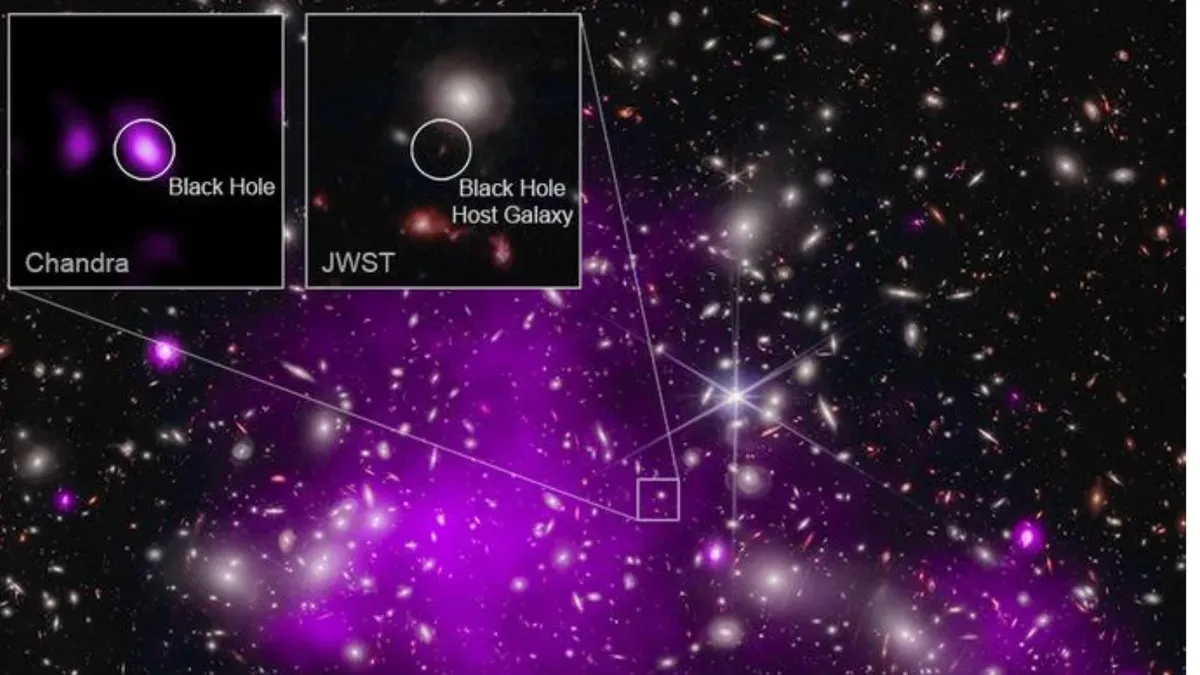
A new theoretical framework proposes that 'dark stars'—hypothetical objects fueled by dark matter annihilation—could resolve three enigmatic observations from the James Webb Space Telescope's earliest universe surveys.
The hypothesis, published in the peer-reviewed journal Astrophysics and Cosmology at High Z (December 2025), suggests these objects might explain the overabundance of supermassive black holes, blue monster galaxies, and little red dots detected in JWST data.
Cosmin Ilie of Colgate University, the research leader, stated: 'Some of the most significant mysteries posed by the James Webb Space Telescope's cosmic dawn data are in fact features of the dark star theory.'
According to the model, dark stars would form before ordinary stars, powered by dark matter particle annihilation rather than nuclear fusion. Their eventual collapse could produce massive black hole seeds, aligning with the rapid emergence of supermassive black holes observed within 1 billion years of the Big Bang.
The James Webb Space Telescope has identified 'blue monsters'—ultra-compact, dust-poor galaxies—and 'little red dots'—compact, UV-faint objects—that challenge existing astrophysical models.
The hypothesis posits that dark stars could obscure UV/X-ray emissions in these little red dots while explaining the extreme compactness of blue monsters. However, the team notes that the theory remains unconfirmed by direct observations and requires further validation through JWST follow-up studies.
The study emphasizes that dark matter exhaustion in these stars could lead to their collapse into black holes, bridging the gap between early cosmic structures and the observed anomalies.
While the framework is grounded in current JWST data, the authors caution that alternative explanations for the anomalies have not been ruled out.
The paper's peer-reviewed status establishes it as a credible contribution to ongoing debates but does not elevate it to consensus.