Cosmic Object with Black Hole Core and Million-Sun Mass Defies Dark Matter Models
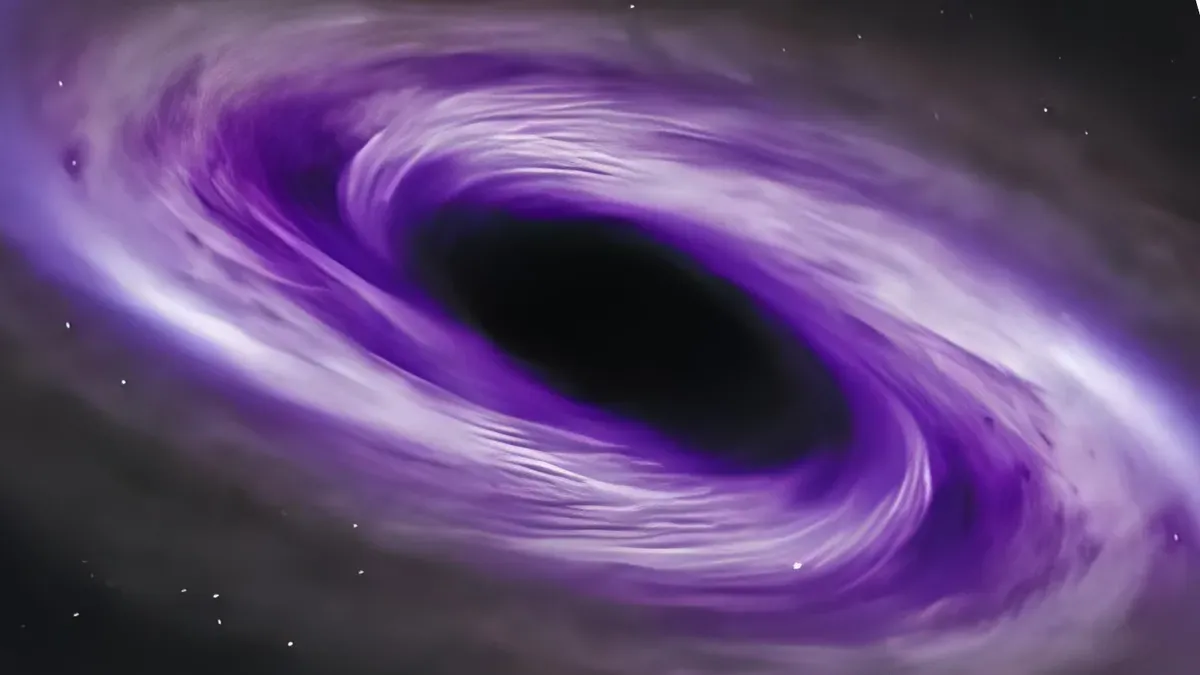
Astronomers have identified a completely dark cosmic object with the mass of 1 million suns, its heart possibly a black hole, existing 11 billion light-years from Earth. The JVAS B1938+666 lens system revealed this anomaly through gravitational lensing perturbations, a phenomenon predicted by Einstein’s general relativity framework.
By analyzing distortions in light from a background galaxy, researchers inferred the presence of an unseen mass disrupting the lensing pattern.
Using data from the Green Bank Telescope and the James Webb Space Telescope (JWST), the team reconstructed the object’s mass distribution. Simona Vegetti of the Max Planck Institute for Astrophysics described the findings: 'The inner central part is consistent with a black hole or dense stellar core... it could be a new class of dark object.' However, the authors emphasize that this hypothesis remains unconfirmed.
Davide Massari of the National Institute for Astrophysics noted the object’s unusual density profile: 'It has a very strange profile... the profile continues to extend to distances much greater than those typically observed.' The mass distribution features a compact core (25% of total mass) transitioning to a flat disk-like structure, diverging from known galactic or stellar systems.
This configuration challenges existing dark matter models, which typically predict different mass distribution patterns.
The research, published in Nature Astronomy on Jan. 5, 2025, highlights the need for further observations. JWST’s advanced spectroscopy may clarify whether the object represents a novel astrophysical entity or an extreme variation of known phenomena.
The team acknowledges limitations in current data, including resolution constraints and the lack of direct electromagnetic signatures from the object itself.