Cosmic Hamburger Unveils Clues to Giant Planet Formation in Distant Disk
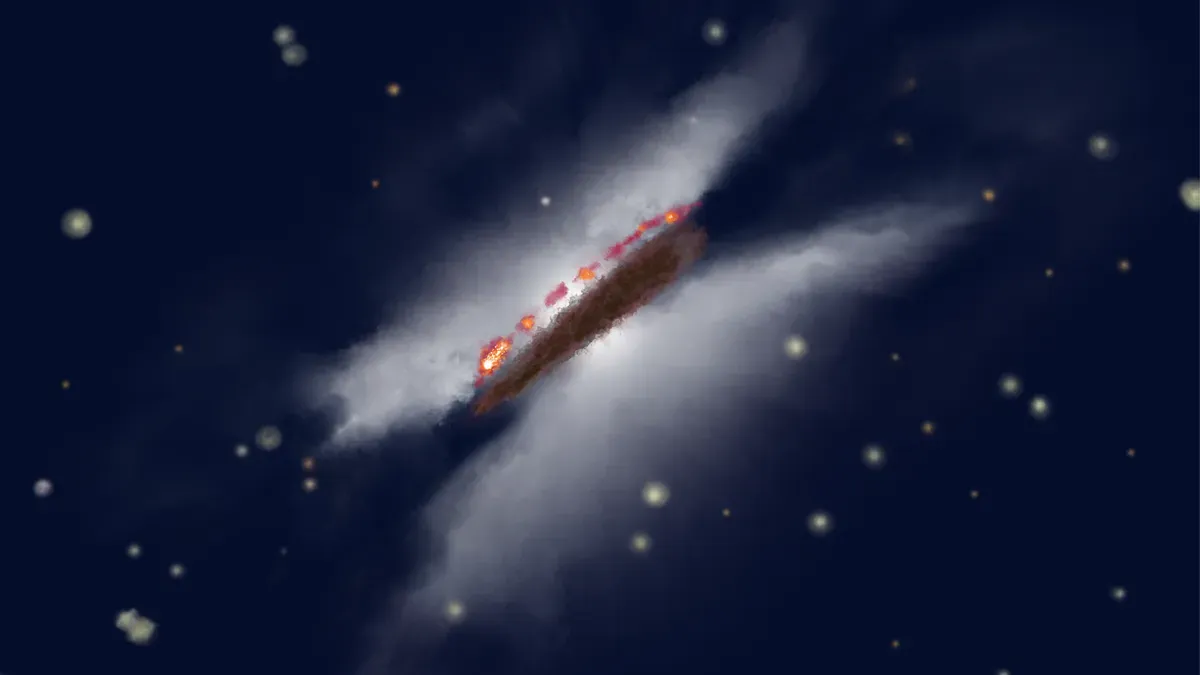
Astronomers have spotted a lopsided 'cosmic hamburger' billions of miles away, where gas layers and dust hint at the birth of giant planets in unexpected ways. The protoplanetary disk 'GoHam' (Gomez's Hamburger) spans 2,000 times the Earth-Sun distance in width and several hundred such distances in height, making it one of the largest observed.
ALMA observations revealed distinct stratification: lighter gases like carbon monoxide and sulfur-based molecules form upper layers, while heavier materials settle below.
This disk exhibits striking asymmetry, including a brighter dust emission on one side, a photoevaporative wind—a stellar radiation-driven gas loss—on the northern edge, and an arc of sulfur monoxide.
A dense clump labeled 'GoHam b' is described as 'a collapsing clump' in the outer disk, potentially representing the earliest stage of planet formation at extreme distances from its star.
'GoHam gives us a rare and clear view of the vertical and radial structure of a very large, nearly edge-on disk... the perfect laboratory for understanding how giant planets can form far from their star,' explains Charles Law of the University of Virginia.
The disk's high dust content enhances its potential to host a multiplanet system, though the team cautions that 'GoHam b' remains an unconfirmed feature requiring further study.
The edge-on orientation of GoHam allows detailed mapping of its gas and dust layers, a critical advantage for studying planet formation dynamics. Photoevaporative winds, caused by intense stellar radiation stripping material from disk edges, are particularly visible in this system.
These observations provide a framework for understanding how giant planets might form at distances where traditional accretion models struggle to explain their existence.