


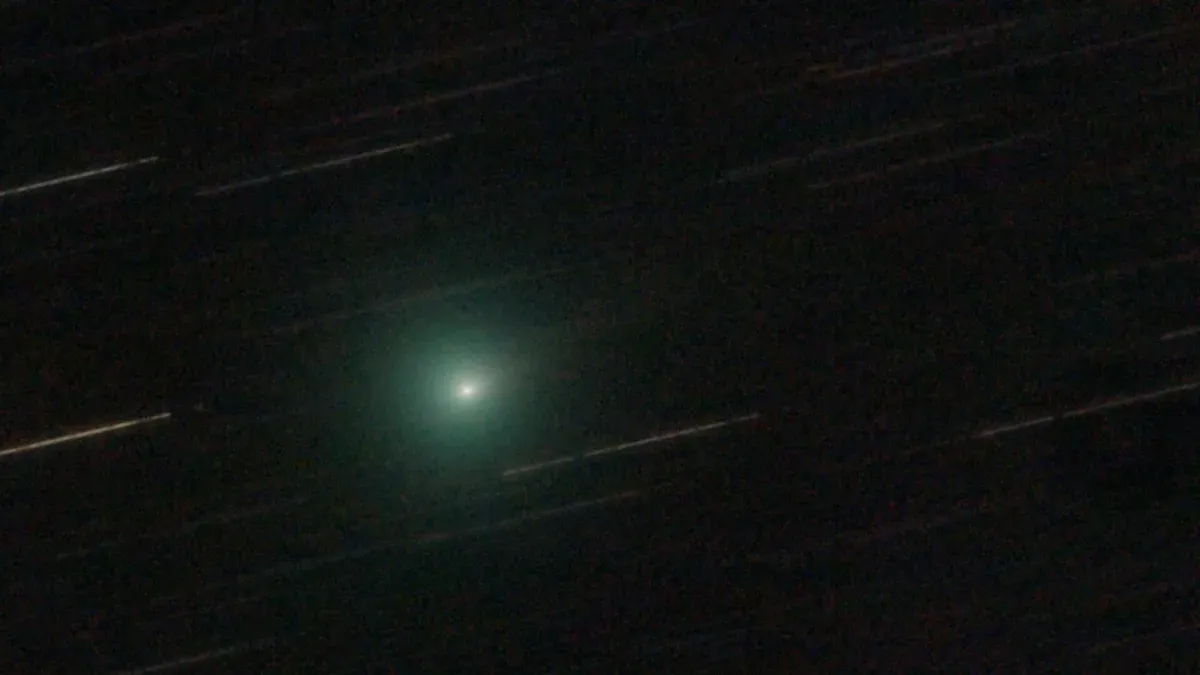
Comet 24P/Schaumasse will reach its brightest point in eight years on Jan. 8, 2026, as it attains perihelion at 109.7 million miles from the sun.
Despite this solar proximity, its observed magnitude of +10.8 ensures it remains invisible to unaided observers, who typically require objects to be brighter than +6.5 for naked-eye visibility.
Observational requirements for this event are stringent. Telescopes with at least a 6-inch aperture are necessary to detect the comet under dark-sky conditions. Its location—5° west of the magnitude +2.8 star Vindemiatrix in the constellation Virgo—provides a reference point for astronomers attempting to locate it.
NASA has confirmed the comet’s 8-year orbital period, aligning with its periodic return to the inner solar system.
Historically, 24P/Schaumasse was discovered in 1911 by Alexandre Schaumasse using a 16-inch telescope in Nice, France.
This discovery predates modern observational tools, underscoring the comet’s faintness even under optimal 20th-century conditions. Current visibility constraints reflect both the comet’s intrinsic brightness and the limitations of human vision.