Black Hole Outflows Switch Between Jets and Winds in Energetic Seesaw
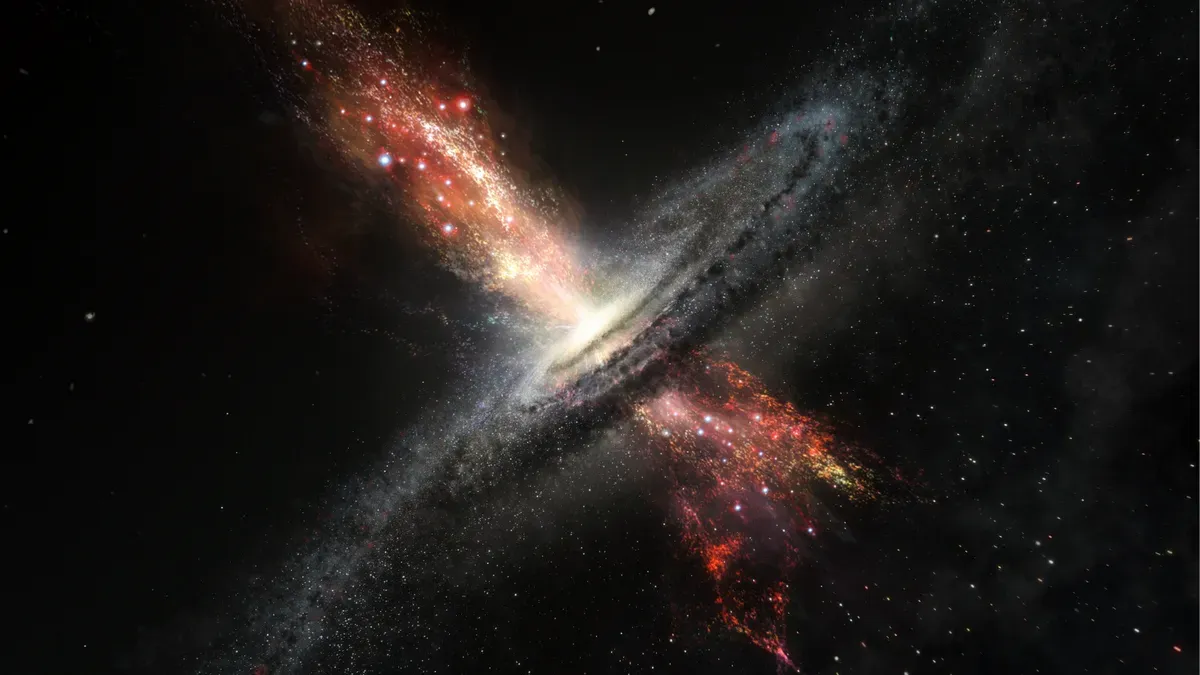
Black holes exhibit a cosmic seesaw effect, alternating between jet and wind production to regulate energy output and influence galaxy evolution. The 10-solar-mass black hole 4U 1630−472 demonstrates this behavior, observed over three years using NASA's NICER instrument aboard the International Space Station and South Africa's MeerKAT radio telescope.
The system never produces both jets and winds simultaneously, maintaining consistent energy/mass outflow regardless of the mechanism.
"We're seeing what could be described as an energetic tug-of-war inside the black hole's accretion flow. When the black hole fires off a high-speed plasma jet, the X-ray wind dies down, and when the wind starts up again, the jet vanishes,"
This self-regulation mechanism suggests magnetic field configurations in the accretion disk control the switching between outflow types.
The findings, published in Nature Astronomy on January 5, 2023, provide constraints for galaxy formation models by clarifying how stellar-mass black holes influence their environments.
"Our observations provide clear evidence that black hole binary systems switch between powerful jets and energetic winds — never producing both simultaneously,"
While the magnetic field theory offers an explanatory framework, the study emphasizes that further research is needed to confirm the exact physical processes governing this dynamic equilibrium.