


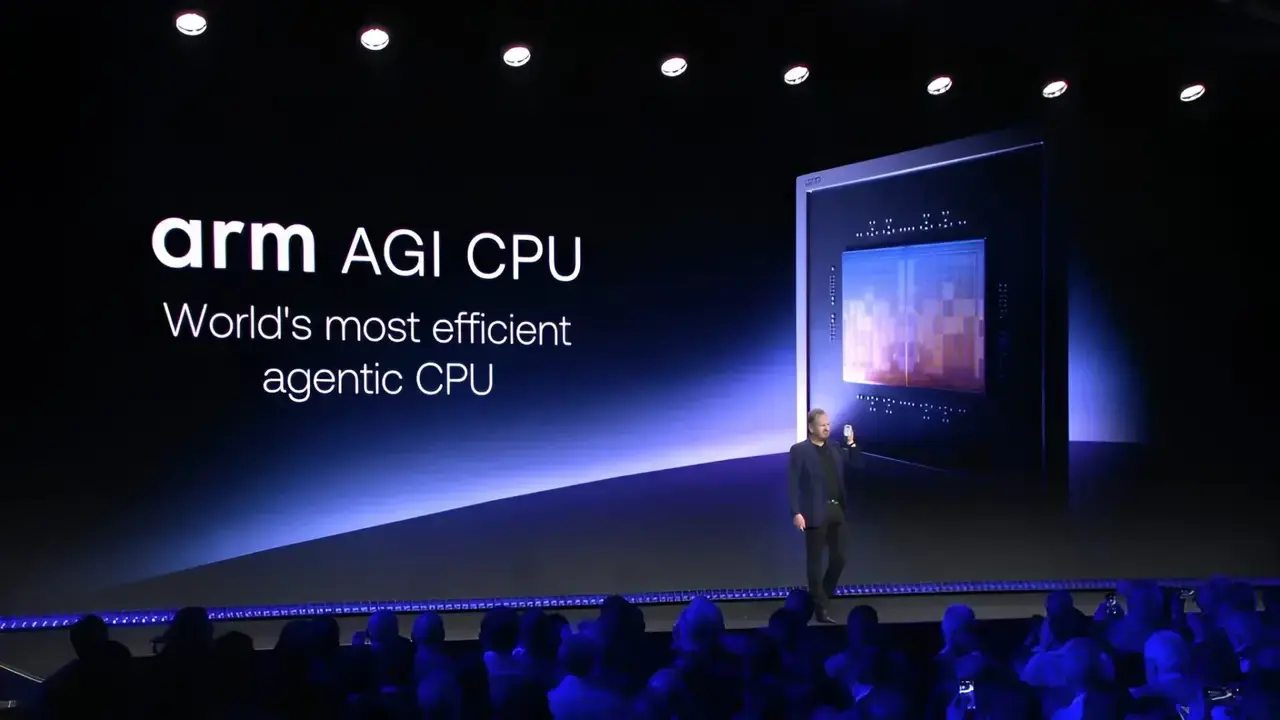
After thirty years of licensing blueprints, Arm just built its own chip, and claims it can double the rack-level performance of x86 while saving $10 billion per GW of data-center spend.
The pivot marks Arm’s debut in production silicon: the Arm AGI CPU, an in-house data-center processor aimed at the exploding market for “agentic” AI workloads that continuously reason, plan and act.
Arm says a single 300-watt device packs up to 136 Neoverse V3 cores, 6 GB/s of memory bandwidth per core at sub-100-ns latency, and can be crammed 60 to a 1U air-cooled chassis for 8,160 cores per rack—or 45,000-plus under liquid cooling.
Meta is lead partner and co-developer, integrating the chip alongside its own MTIA accelerators. Arm lists another 14 customers — Cerebras, Cloudflare, F5, OpenAI, Positron, Rebellions, SAP, SK Telecom among them and four launch ODMs (ASRock Rack, Lenovo, Quanta, Supermicro) with early systems shipping now and wider availability slated for the second half of the year.
According to Arm’s own math, the AGI CPU delivers “more than 2× performance per rack versus x86 CPUs,” translating into “up to $10B in CAPEX savings per GW of AI data center capacity.” The company also projects that agent-driven applications will force data centers to carry “more than 4× the current CPU capacity per GW,” making power-efficient replacements attractive.
Rene Haas, Arm’s CEO, framed the move as inevitable:
“AI has fundamentally redefined how computing is built and deployed. Today marks the next phase of the Arm compute platform… giving partners more choices all built on Arm’s foundation of high-performance, power-efficient computing.”
Arm will keep licensing cores and pre-integrated CSS bundles, but the addition of finished silicon means customers can now buy Arm-branded parts instead of building their own, an option Intel and AMD have long offered and one that could squeeze traditional server CPU incumbents if the efficiency claims hold under third-party scrutiny.
Early silicon is already in Meta’s hands; the rest of the industry will decide whether Arm’s first chip is a bargain or just another press-release benchmark.