


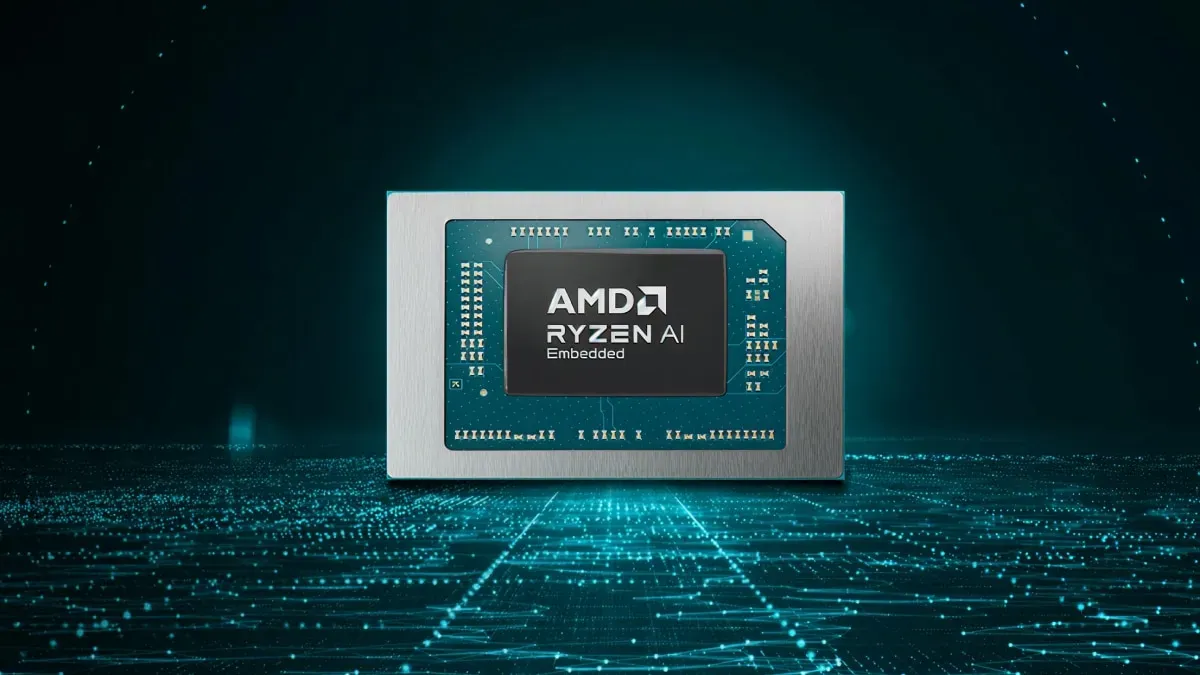
If your factory robot or ultrasound cart feels sluggish, AMD’s newest embedded chips claim they can cram a data-center’s worth of AI into a motherboard the size of a postcard—no extra GPU card required.
The Ryzen AI Embedded P100 Series scales from 4-12 Zen 5 cores and pushes up to 80 system TOPS on a single die, a spec sheet that sounds impressive until you remember most fanless industrial PCs still throttle at 15 W.
AMD isn’t quoting prices yet, and the gap between sampling now and July 2026 shipments gives Intel, Nvidia, and Qualcomm almost a year to spoil the party.
Advantech’s Aaron Su framed the pitch:
"Featuring Computer-on-Modules, Single Board Computers, and Edge AI and Intelligent Systems, this portfolio leverages an enhanced integrated AI architecture to deliver high-efficiency multitasking that drives next-gen Edge AI advancement."
Florian Drittenthaler at congatec echoed the modular mantra:
"It enables customers to precisely tailor performance, power, and cost to their specific application needs by offering four to 12 CPU cores and highly scalable GPU performance."
Translation: vendors can bin the same silicon into everything from a headless PLC to a 3-D imaging box running U-Net models, provided they accept whatever TDP ceiling their enclosure allows.
AMD says the new parts deliver 39 % higher multithreaded CPU throughput and 2.1× total system TOPS versus the prior Ryzen Embedded 8000 Series. The ROCm open-source stack plus HIP runtime promise CUDA-free framework porting, a dig at Nvidia’s licensing grip on embedded AI.
Use-case slides show PLC+HMI consolidation, mobile-robot vision-language-action models, and MONAI-based medical segmentation—all workloads that historically required a discrete GPU or a chunky NPU card. The idea is to shrink board real estate and cut cable clutter, not necessarily to hit 80 TOPS in a passively cooled box.
Still, without list prices or a firm TDP ladder, it’s hard to tell whether the P100 will undercut Intel’s Core Ultra-H or Qualcomm’s RB5. And while the 4-6-core SKUs are slated for Q2 2026 production, the 8-12-core parts won’t ship until July—plenty of runway for competitors to answer with faster, cheaper, or simply sooner silicon.
Look, I’ve seen too many “one-chip-does-all” banners end in firmware purgatory once thermals meet reality. If AMD can deliver 80 TOPS at 15 W without throttling, we’ll have a story; until then, keep the screwdriver handy.
Source: AMD