



Every new block is deepening the hole—Bitcoin miners are now torching $19,000 per coin as war-fueled energy spikes collide with plunging network difficulty.
Checkonchain’s difficulty regression model puts the average production cost at $88,000, while Bitcoin changed hands at $69,200 on 13 March. That gap leaves miners absorbing an $18,800 loss on every freshly minted coin.
Network difficulty dropped 7.76% on Saturday to 133.79 trillion, the second-largest negative adjustment of 2026. Hashrate has retreated to roughly 920 EH/s from last year’s 1 zetahash record, and the next downward reset projected for early April would extend the slide if Bitcoin cannot reclaim $88,000.
Oil above $100 and the effective closure of the Strait of Hormuz have lifted global energy prices. An estimated 8–10% of global hashrate sources power from affected markets, so every cent added to the kilowatt-hour bill eats further into already thin margins.
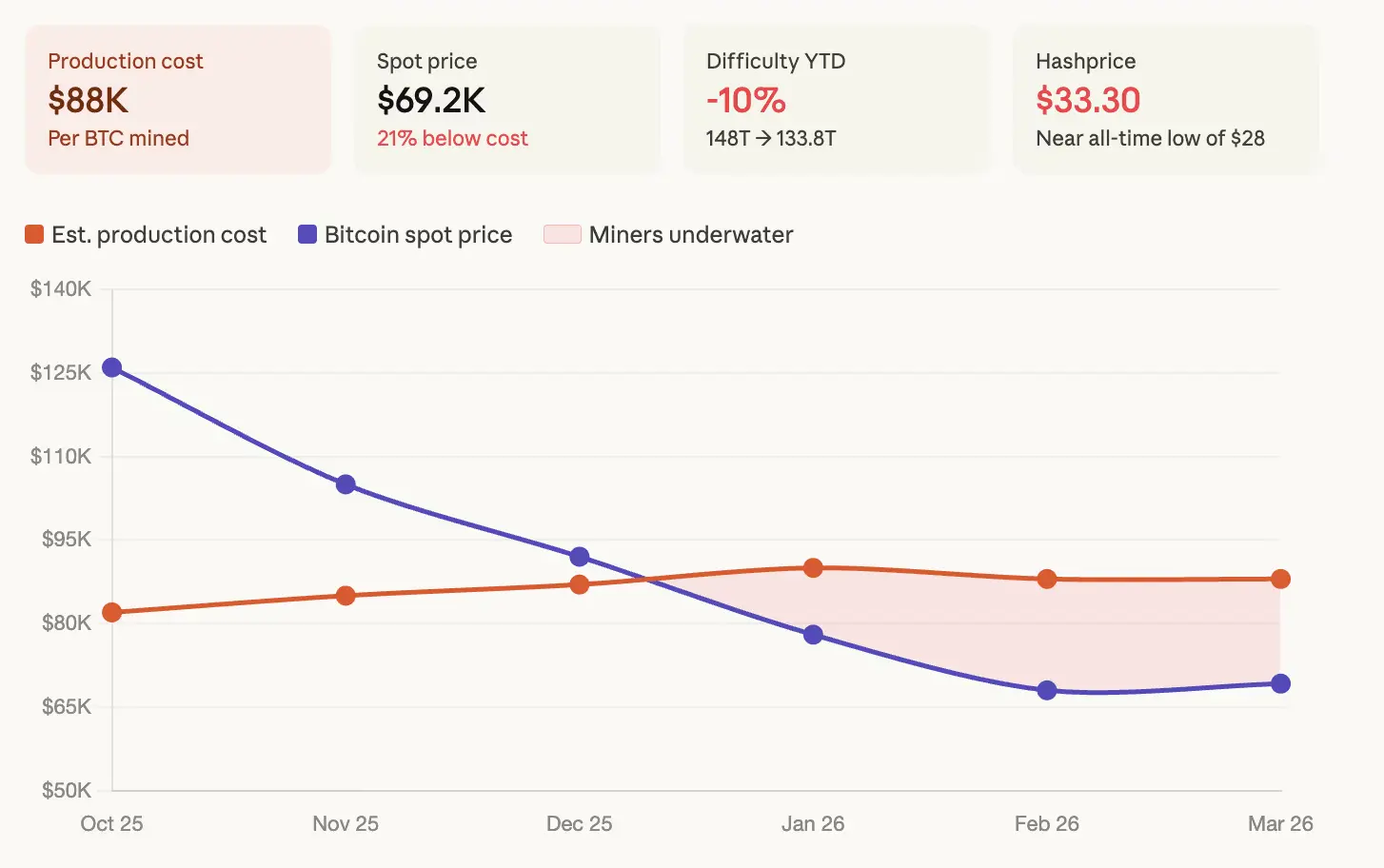
Hashprice—the daily revenue one petahash can earn—hovers around $33.30, just $5 above the all-time low of $28 set on 23 Feb, per Luxor’s Hashrate Index. At this level, even new-generation rigs tread water after electricity, rent, and staff costs.
Miners are responding by liquidating more of their treasury and pivoting toward AI and high-performance computing. Marathon Digital and Cipher Mining are expanding data-center capacity to house GPU workloads, betting that diversified revenue can cushion volatile coin margins.
On-chain data show 43% of total Bitcoin supply is underwater at current prices, and the forced-selling feedback loop could intensify if cash-flow stress spreads from smaller farms to listed operators.
With breakeven so far north of spot and another difficulty drop likely, the arithmetic is brutal: either Bitcoin rallies past $88,000 or more hashrate will unplug, pushing difficulty down again.
⚠️ LEGAL DISCLAIMER: This article is for informational purposes only and does not constitute financial or investment advice.
Source: Coindesk